Storytelling Techniques from Babylon 5: Beginning an Epic

This is part of a series about storytelling techniques for epic fantasy. I’m drawing my examples from the 1990s sci-fi TV show Babylon 5. If you’ve never seen it, that shouldn’t affect the validity or usefulness of my storytelling tips. If you do want to see the show, you can probably find it on Netflix or the DVDs on eBay.

The plot of Babylon 5 was told over five television seasons and a few TV movies. Never mind the ‘90s hair and CGI that’s outdated by today’s standards. The story itself was a sprawling epic fantasy with a space-opera setting, a story that spanned thousands of years and dozens of characters. J. Michael Straczynski was the mastermind behind this dramatic tale of humans and aliens, ancient prophecies and futuristic empires, villains and heroes.

A question that often plagues writers of every genre is “how do I begin the story?” This is more than just a question of choosing the perfect first sentence. It’s about deciding the most appropriate moment of the main character’s life and story to bring in the reader.

This can be especially challenging with an epic story, because, by its very nature, it has a history and long-range repercussions that may not actually be part of the main plot. How do you begin such a long story without giving a boring history lesson?

The Beginning?

The Babylon 5 pilot episode begins with one of the main characters of the series, Londo, giving a brief narration. He explains that this is the beginning of the story of a new space station called Babylon 5, but the audience also learns that it’s really an ending—Babylon 5 is the last of the Babylon stations. Four other space stations and their missions went before this one, and those stories—as yet untold—are the foundation on which the current story is built.

Any truly epic story is always at the beginning, at the end, and somewhere in the middle, because plot threads and characters are intertwined across time or distance. There’s no catch-all answer to the question of “where do I begin my story”—each plot and set of characters are unique. A guideline to consider, though, is beginning with an upsetting of the status quo.

As lovely as it is for real life to pass along without upsets or disasters, it makes for a somewhat tedious story—especially if you’re wanting to tell a long-running saga. Quickly establishing the norm—and upsetting that norm—jumpstarts the action and introduces the audience into the minds of the characters.

In Babylon 5, Londo’s brief narration (notice my emphasis on brief—let’s avoid that boring history lesson) explains that this final Babylon station is dedicated to serving the interests of peace. (This also hints that maybe the previous four Babylon stations didn’t succeed at this mission of peace…but more on foreshadowing in a different post).

Upset the Norm

The norm is established during the first few minutes of the story, through narration and the characters interacting in the setting. This is a space station in neutral territory, serving as a peaceful free port for all cultures, several of whom are rebuilding after long and violent wars. Then the norm is upset—an assassination attempt, cultural misunderstandings, and a surprise attack. Babylon 5’s mission of peace is immediately put to the test. And thus a plot is born.

It should also be noted that while the problem is introduced right away, it is not every problem that ever will be in the plot of the entire epic. In a long saga or a series, there is usually one over-arching plot, and then any number of smaller plots that feed into the main theme of the story. It’s important to establish the main plot fairly quickly. It can then be developed, via subplots, side plots, and other storytelling threads, over the course of the tale.

In this example, the main plot is established immediately—a threat to intergalactic peace. Many other plots feed into this during the course of the series—the Shadows returning after a thousand-year hiatus, the Minbari government crumbling, the enslavement of the Narns, the dictatorship on Earth, and on and on.

But all of these are part of the main plot—war encroaching on peace—and that core concept is the plot that is revealed right away. All of those other plots are not even hinted at right at the beginning. That’s the point of an epic—all of these related plots need time to develop. Upset the status quo as soon as possible, but don’t throw in everything at once. The audience needs time to learn about the characters and situations involved so the impact of each new plot thread will be felt.

I’m not going to discuss world-building in this post, even though that’s a vital element to any fantasy or sci-fi epic. The norm of the world of Babylon 5 is established as quickly as the main theme of the plot. In the first ten minutes of the pilot, we know that it’s in the future, on a space station, and there are humans and aliens from countless cultures all living together. The depth of this world is revealed in more detail as time progresses.

The same can be done in the first few pages of a novel. Establish the basics of the norm—both the setting (world) and the situation. Then when the problem enters the picture, the reader can learn about the world at the same pace that they are learning about the characters and the plot—because both the characters and their world are part of the fixing of the problem.

The trilogy that I’m writing may or may not qualify as an “epic.” And hopefully I’ve followed these guidelines with my own beginning. I guess my critique partners and beta readers will let me know! Keep reading for the next few weeks—I’ll be writing about some more elements of telling an epic story.

“And so it begins.” – Kosh, “Chrysalis”
The Nitty-Gritty of Writing: Homophones

So what is a homophone anyway, and why should a writer care? Homophones are words that sound the same, but have different spellings and meanings (homo=the same, phone=sound). These are words that are fine when you’re speaking them, but writing them can sometimes be a bit more confusing.

For this post, I’ll highlight three sets of homophones that I see giving people the most trouble. Here are two words that I see misused and mixed up the most often: you’re and your. You’re is a contraction of you are (see my previous nitty-gritty post about the apostrophe). Your is possessive, meaning that the word represents something belonging to you. The best way to break it down and remember which one to use when writing is to break up the contraction of you’re.

Correct:

I think you’re going to enjoy this book. (I think you are going to enjoy this book.)

Is that your book? (Is that the book that belongs to you?)

Incorrect:

Your very pretty. (Your pretty what? What belongs to you that’s very pretty?)

Let’s take you’re car to the store. (Let’s take you are car to the store. Makes no sense.)

Another common homophone mix-up is they’re/their/there. One of these is a contraction, like you’re, so again, you can split it up into its component words to clarify the meaning for yourself. As for the other two words, someone might have an easy to trick to remembering which spelling means what; but, failing that, you’ll just have to memorize them.

They’re is a contraction of they are.

Their is possessive, referring to something that belongs to them.

There refers to a place or location, usually a little farther away than here.

Correct:

They’re running late. (They are running late.)

I love Fluffy, but he’s their cat. (I love Fluffy, but he belongs to them.)

The book is on the table over there. (The book is on the table a short distance away, rather than table here close by.)

Incorrect:

Their running late. (Being possessive, using their makes no sense. What belongs to them that is running late?)

I love Fluffy, but he’s there cat. (Meaning the cat that is there instead of here?)

The book is on the table over they’re. (The book is on the table over they are. Um, what?)

Some other commonly misused homophones:

To/too/two:

To is a preposition, and usually refers to direction or is the infinitive form of a verb. He went to the store.

Too means also. I love pizza with pepperoni and mushrooms—and sausage, too!

Two is the number after one and before three. I was hungry so I ate two burgers.

Hear/here:

Hear means to listen or to be aware of sound. I hear the neighbor’s dog barking again.

Here is similar to there, but usually closer. Sit here on the sofa next to me.

By/buy/bye:

By is a preposition, and usually functions as from or as part of a location. This book is by my favorite author. Come by my house at ten.

Buy means to purchase or accept. I need to buy dog food tonight.

Bye is a shortened form of good-bye, a farewell greeting. Bye, Jimmy! See you in school tomorrow.

Yes, English can be a confusing language, and the abundance of homophones doesn’t make it any easier. If you text your friend that “their running late,” he or she will usually know what you mean and it’s not a big deal. But if you’re turning in a paper for school, or a short story for your creative writing group, or writing a blog post selling your services as an editor, these little homophone mix-ups become a much bigger deal.

If you hear of a trick to help you keep straight which spelling means what, please share! But otherwise, good old fashioned memorization (and maybe another pair of eyes to read over your work) will be your best friends for helping with homophones.

Music Review: Live Concert – Eivør

I’ve written several music reviews on this blog, and I think I might like to make a habit of reviewing live shows, as well. For that to happen on a regular basis, I’d need to either travel more to find my favorite bands (that would be awesome), or have them come closer to me (that would also be awesome).

This past week, one of my favorite singers did indeed come to me. Faroese singer/songwriter Eivør performed in Washington, D.C. as part of a Nordic exhibition at the Kennedy Center for the Performing Arts. (I reviewed Eivør’s most recent album Room a few months ago).

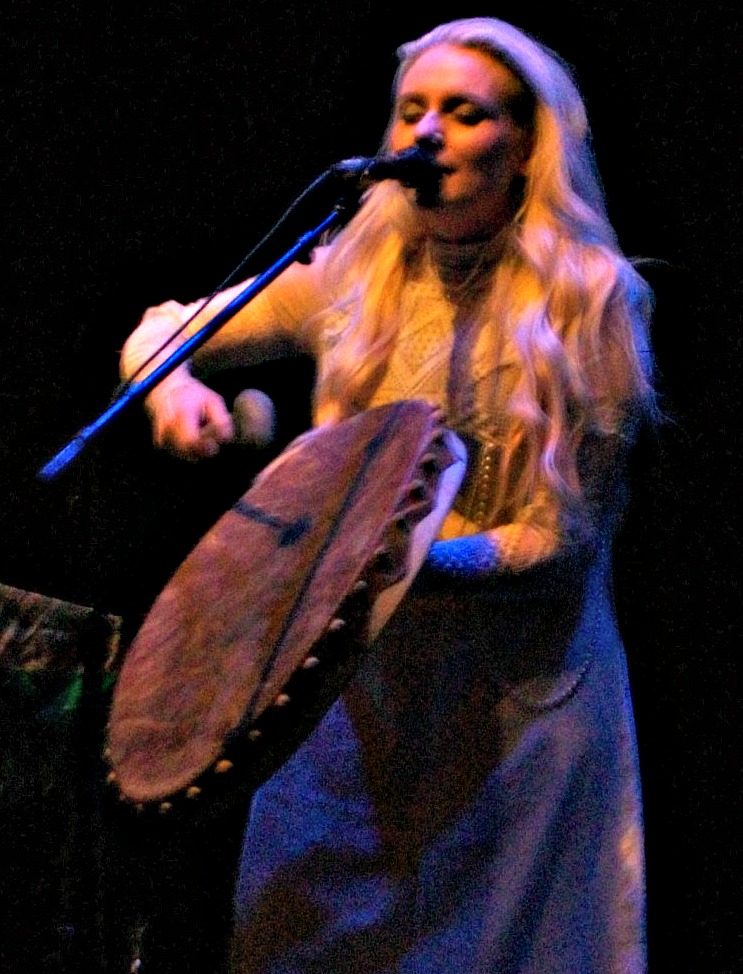
The concert began gently, as Eivør came onto stage alone—barefoot, wearing white, and silent. She began with the Faroese lullaby “Rura Barnið,” played on the kalimba (thumb piano). The bell-like tones of the thumb piano transitioned seamlessly into the musical intro to “Green Garden.”

Songs from her latest album Room was the theme of the show—she sang “Boxes,” “True Love,” “Eg Veit,” and others. “Rain” was one of my favorites from this concert. Before beginning the song, Eivør announced that she was going to try something she’d never done before, and laughingly apologized in advance if it didn’t work.

The audience sat alert in anticipation as she adjusted the microphone on her mandolin, and then bent over the instrument and sang into it. Using the mandolin’s mic to capture the wailing chant that is the intro to “Rain” was a success, and after a delighted grin to the audience, Eivør played back the track and launched into the song.

I wish I’d been fast enough with my camera to capture that moment. Most musicians sing with their instruments—but leave it to Eivør to take music to a new level of unique by singing to her instrument.

The gentle Nordic fairy that is Eivør on stage disappeared briefly during songs like “Nu Brenner Tu I Mær.” Suddenly she was an angry Viking goddess, full of power and passion.

And just as powerful—maybe more so—was her performance of “Trøllabundin,” another of her classic Faroese songs. For this song, her accompanists left the stage, and Eivør had to fill the space with just her voice and a frame drum.

And fill it she did. Part way through the song I realized that I had closed my eyes. Her voice—quiet and mesmerizing, then loud and primal—enchanted me to a place far beyond the city of Washington.

“Falling Free” was the final song. Eivør’s lingering voice hung in my mind like an eternal free-fall long after the song was finished. The concert ended as it had begun—in beauty and pure music.

If you get a chance to attend one of Eivør’s live concerts, I would highly recommend doing so. And put in a good word for me to ask her to come back to the USA sometime, too. I’m sure she gained some more American fans after her D.C. performance!

Eivør’s website: www.eivor.com

Kennedy Center Feb 046

Borrowed Words

Every language is influenced by other languages. And every language winds up adopting foreign words over time, sometimes adapting them to unique uses in the new language, and sometimes keeping the form and definition the same.

For this blog entry, I thought I’d highlight a few common words that are used in modern English that actually have their origin in another language far removed. Such words are usually called “borrowed words,” which personally I find to be a strange term. The language and its speakers don’t temporarily borrow a foreign word with the intention of giving it back someday. “Adopted words” would be more accurate, in my opinion; but for now I’ll go with the more well-known linguistic term.

Buffet—a self-serve spread of food, often found in restaurants such as an all-you-can-eat cheap Chinese buffet. This word is French, and it originally referred to the sideboard (or side table) where food was laid out to be served to seated diners at the dining table.

Kayak—a narrow one- or two-person boat steered with a two-ended paddle. It’s an Inuktitut word (often spelled “qajaq” in that language). The Inuit and Eskimos of the Arctic used this boat for centuries for hunting and travel before we adopted it for recreational use.

Piano—a musical instrument constructed of keys which use hammers to strike strings to produce the sound. It’s part of a longer word pianoforte, which is Italian for “soft-loud.” It meant that this musical instrument, unlike many others of centuries ago, could be played both softly and loudly.

Sauna—a hot room, either steamy or dry, used for relaxation, rejuvenation, and all manners of sweating. We get the sweat-room concept, and the word, from Finnish. The Finns love their saunas.

Bazaar—a large shopping venue, with many stores or booths selling a variety of merchandise. Bazaar is a Persian word, and us English speakers liked it so much we now use the word for everything from art shows to farmers’ markets to catalogs.

Geyser—a hot spring that erupts from beneath the ground with explosive force, often at regular intervals. Iceland is a land where many geysers can be found, and that’s where the word comes from. “Geysir” in Icelandic is both the general term for this natural phenomenon, and the name of one of the island’s largest geysers.

So there you have it—who knew that English uses so many words that aren’t English? And I could list many others. Anybody else have other suggestions to add to the “borrowed words” list? How about some words “borrowed” into other languages besides English?

THE NEXT BIG THING – Blog Hop

I did a blog hop about the Next Big Thing once before, but I thought it’d be fun to give it another go. I will be answering several questions about my WIP. In the first “interview” about the Next Big Thing, I talked about the second book of the trilogy I’m doing, because I’m currently writing the first draft of it. For this blog “interview,” I’ll talk about the first book, which is in the rewrite and first round of edits stage.

1: What is the working title of your book?  

The Vanished Reindeer. The trilogy is titled The Light-Whisperers of Kalevala.

2: Where did the idea come from for the book?

I wrote a blog post once specifically about that. The idea came from a thought about a herd of reindeer and a mystery—and to solve the mystery for myself, I turned to the realm of fantasy.

3. What genre does your book come under?

Fantasy. Specifically, cross-world fantasy (where the story takes place both on earth and in a fantasy world), with a dose of mythology-inspired fantasy.

4: Which actors would you choose to play your characters in a movie rendition?

Dunno. I’m still working on this one. Most of the actors would need to be Finnish, as the story is set in Finland and only one of the characters is American.

5: How long did it take you to write the first draft of your manuscript?

About a year and half to finish the first draft.

6: What else about your book might pique the reader’s interest?

Well, let’s see—are you a reader who likes fantasy that pulls elements from mythology and classic literature? Are you a reader who likes a good Scandinavian mystery? Are you a reader who likes mysterious monsters, immortal queens, magic, music, and just a dab of romance? My book has all of that—hopefully tied together in a nice cohesive package. That’s what this rewriting/editing phase is for.

Many thanks to Bonnie Watson for sending me this blog hop entry. Check out her books at www.WisdomNovels.com!