Books make good Christmas Gifts

For the month of December, my posts will all be Christmas-themed, just to be festive (or annoying, depending on your point of view). You can love it or hate it, celebrate it with joy or celebrate a different winter-time festival—but either way, Christmas is here and so is its impact on our culture. So I figured it would be appropriate if my blog reflected that.

Since it’s the season for buying lots of stuff to give to other people, I decided to compose a short list in support of buying a book as a gift for your friend, family member, or even co-worker who you don’t really like. In the future, when I have some published works under my belt, this would of course apply to you, dear reader, buying (cough cough hint hint) one of my books. But since I’m not published (yet!), you can go spend your money with other authors for this Christmas.

So here’s my list of Christmas shopping tips, and why I think you should spend your money on books:

-Books are the gifts that keep on giving. A good story, or even a good non-fiction book, can be enjoyed again and again, and can be enjoyed by multiple people for years after the moment of the giving.

-Even if someone doesn’t like to read, there’s a book out there for them. It may not be hard to shop for the teen who’s into YA fantasy novels, but what about those other people? Well, even non-reader Uncle Bob might enjoy a glossy photo-filled book about his favorite wines, or a book of sports cartoons might be the perfect Secret Santa gag gift for your co-worker.

-If you’re buying an e-reader as a gift, it would add that little something extra if you spent a few dollars more and put a book or two on there. Especially if the person receiving the e-reader has never used one before or isn’t especially tech-savvy, having some ready-to-read books on it will make the gift that much more personal and user-friendly.

-Books don’t have to be expensive gifts. Sure, you can buy that $50 glossy hardcover coffee table book. But if your budget (and/or long list of people to shop for) doesn’t work well with that, you can still buy books. Most paperback fiction can still be bought for under $10. And don’t forget e-books, many of which are cheaper than that. And many small press and indie authors have special deals on their own websites with discounts or free gifts at this time of year, so check out author websites.

-Buying a book supports the author, so it’s like two gifts in one. Whether the author is a gajillionaire like J.K. Rowling, or a struggling indie writer you’ve never heard of, every book was lovingly crafted by somebody. Somebody put time, thought, energy, money, and love into every paperback, non-fiction book, and e-book out there. So if you buy a new book for a gift, you’re also giving to that author, and they deserve a merry Christmas too.

How many of you like to give or receive books as gifts?

A Quick Traveler’s Guide

Today’s post is a little random, for two reasons: a) I’ve been sick for two days and therefore have been massively unproductive and couldn’t think of anything else to write, and b) it’s the last few days of NaNoWriMo and I’m frantically trying to pound out a few hundred more words (I’m embarrassingly far away from the 50k word goal, but that’s a different topic).

One of my dreams/day-dreams is to be a travel writer. The first key to that is, of course, being a traveler. I’ve been to a handful of US states and three foreign countries, but I doubt that’s enough to qualify me as an “experienced” traveler, or worthy of writing a book about traveling.

I think it does qualify me, however, to write a blog entry about some of the places I’ve been. So here’s my quick-and-easy guide to getting by in select international venues:

Costa Rica (specifically San Jose, and a Pacific-coast resort that I can’t remember the name of):

Tip #1: It’s always temperate weather. Houses and public buildings are built open-air or with windows that cannot be closed.  Very odd for someone who comes from a place that requires A/C in the summer and heating in the winter, as well as protection against hurricanes and ice storms. Nothing but sunshine (and humidity) in Costa Rica!

Tip #2: Black sand beaches are cool, but they’re surprisingly similar to white sand beaches. It’s a beach with sand. Only it’s black. It was my first view of the Pacific Ocean, though!

Tip #3: Not very many people speak fluent English. Conceited American here, who expects everyone to speak their language. No, I did not go there actually expecting everyone to speak English (although my friend who I was visiting spoke English). I attempted to brush up (that is, learn from scratch) some Spanish, but I don’t think I ever managed more than “please” and “thank you.”

Beautiful black sand beach

Beautiful black sand beach


England (specifically, London—and only some parts of London. It’s a really big city):

Tip #1: When they say “Mind the gap” when you’re loading or unloading at a tube station (underground rail), they’re not kidding. At some stations, the gap between the train car and the platform is large enough to lose a Rottweiler in. Heed the warnings of the nice British lady’s recorded voice when you’re on the subway, folks.

Tip #2: If you want to shop for a few days in a row, go to Portobello Road. It’s closed off to traffic on the weekends (I think that’s when we went), and it’s miles (or kilometers) of shops, street vendors, street musicians and performers, and more shops. Lots to see and do and buy, and as a bonus, you’ll get that song “Portobello Road” from that old Disney movie stuck in your head for the rest of the day.

Tip #3: Not very many people speak fluent English. London is the melting pot of the world, and I heard more languages on a daily basis on the streets of London that I’ve heard collectively my entire life. And those people who do speak fluent English speak British English, which might as well be a foreign language to my American ears.

Much shopping to be had on Portobello Road

Much shopping to be had on Portobello Road


Norway (specifically Bergen, and a scenic fjord about 45 minutes outside the city):

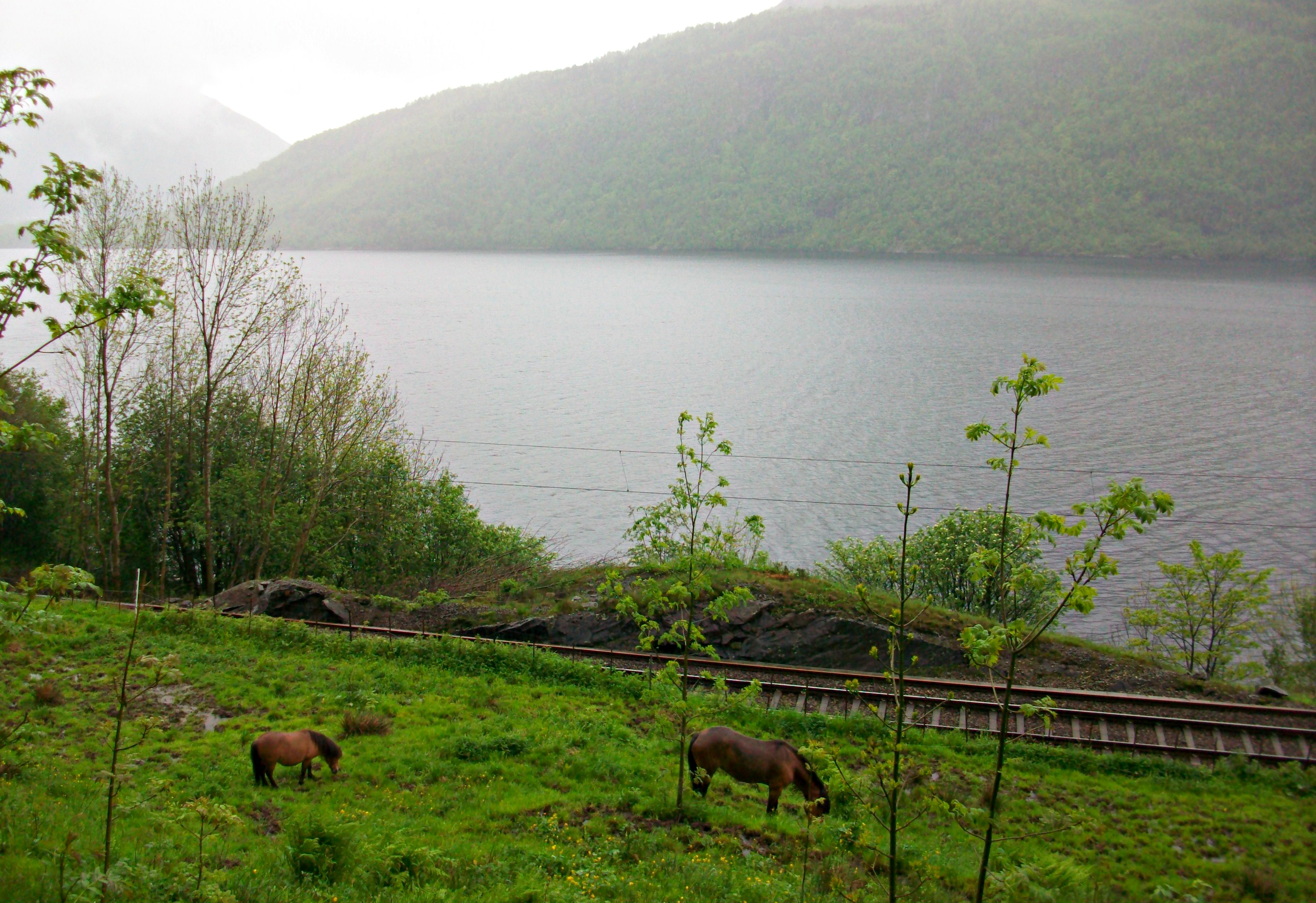
Tip #1: The flora and fauna of Norway are beautiful, especially out by the fjords. For someone who comes from the east coast of the USA, where we think that Afton Mountain in Virginia is a tall mountain, the mountains of southern Norway totally blew me away. There are also these little neon-green birds that live out in the wilds—they looked almost fake they were so brightly-colored, but I was assured that they were quite real. The birds like to snack on the giant black slugs that come out after it rains (which is does about eight days a week in the Bergen area), so watch where you step.

Tip #2: The currency is a tad confusing for us simple-minded Americans. You feel all rich marching out the door with 2,000 kroner in your pocket, until you realize that equates to less than 400 US dollars and a bowl of soup is going to cost you about a bazillion kroner.

Tip #3: A lot of people speak fluent English. Thanks goodness, because I went to Norway knowing less Norwegian than I did Spanish when I went to Costa Rica. Again, I had a friend with me who was bi-lingual, but it was nice that most people there were bi-lingual as well. I always had to ask people to say it in English, though—because of my pale looks and my lack of tourist-y fanny pack and camera, everyone assumed I was Norwegian. While this was flattering, it was also embarrassing, since the only word I mastered while there was “takk.”

Horses grazing by a fjord. Beautifully scenic.

Horses grazing by a fjord. Beautifully scenic.


So there’s my first foray into travel writing. No offense is meant, of course, to any of those countries or the people in them. I loved all of those trips, and met friendly people and had great experiences. Anybody else have a humorous or useful travel tip about a place you enjoyed visiting?

Giving Thanks

Here in America, this is the week that we celebrate Thanksgiving. It’s one of my favorite holidays.

Instead of a regular post, I’m just going to list out a few things that I’m thankful for.

I’m thankful for the God of the universe who created me and who loves me.

I’m thankful for my love of writing. It’s one of the things that makes me happiest.

I’m thankful for loving parents and a wonderful family and circle of friends. I’m thankful for my sister, who has always been my biggest supporter and is often my muse, my editor, my brainstorming partner, and my beta reader.

I’m thankful for all the great books out there that have been written, and all the ones that have yet to be written.

I’m thankful for all of the wonderful experiences I’ve had so far in my life and all the places I’ve been to; I’m thankful that there are so many more places to see and things to do that I have to look forward to.

I’m thankful to be living in this time, where the power of technology enables me to hear music and read books from places I never even knew existed before, and allows me to connect with amazing and talented people all over the world.

I’m thankful for all of the people who read this blog. I hope I’ll continue to write things that you want to read!

Enjoy this holiday, and remember to appreciate the things you’re thankful for!

World Building, part 2

Last week I covered three guidelines for creating a convincing world in fantasy and science fiction. I’ve got three more to add to that list.

1. Do your research

This may seem counter-intuitive or unnecessary for something that isn’t real anyway, but some of the best sci-fi and fantasy is well researched before it’s written.

My post on natural laws in the previous world building list could be part of this “research” aspect. Things have to make logical sense within the world that you create.

If you have an alien planet with a gravity of ten times that of earth’s gravity, chances are that the dominant species on that planet will not be humanoid up-right bipeds. A creature with a human-like form and physiology would not be able to withstand the intense gravity. Let your creativity flow, but do a little research first.

For another example, let’s say you’re writing a fantasy story about a medieval-like kingdom battling an invading army. Both sides are using bows and arrows, swords, horse-drawn chariots, and the like. However, if you have an army of women bounding through the treetops, swinging from branch to branch shooting at the enemy with longbows, you might want to stop and do some research.

Longbows can stand six feet high, and shoot an arrow with enough force to pierce through thick metal armor. The bows are much too large and heavy to be wielded by someone bounding through the treetops. This is not to say that you have to become an expert on medieval archery to write a fantasy battle (I probably got some of the details wrong myself in that little illustration). But my point is that a little research on some of the key topics could save you embarrassment later.

2. Names and Languages

Many writers like to invent languages—or at least words and phrases in other languages. Most of us aren’t as adept as Tolkien was, writing several full-fledged dialects of his Elven language. But inventing a few words, or even a system of grammar and syntax, can be a fun challenge and can add a layer of realism to any fantasy story.

Character names should reflect the language, if there is one, and should definitely reflect the setting and the culture. Just imagine how jarring and inappropriate it would have been if Tolkien had tossed in a Braedan and an Emma in with Elrond and Galadriel, or a Josh and Mary in with Théoden and Éowyn.

In my current WIP, I haven’t invented any languages, but I do have characters from several different cultures—and the names are distinct to each culture. One set of creatures—the rulers of the woodland areas—have names that reflect who they are: Forest Dreamsong, Moon in the West, and Summer River. Another kind of creatures have names like Sydämen-Syöjä, Iku-Turso, and Ajatar. There’s no confusion as to which character might belong to which culture.

3. Consistency and Continuity

This is really the most important of all of these world building guidelines, I think, and one that I’ve mentioned repeatedly. No matter how much research you do, or what natural and cultural laws you establish or how many names you invent, the key is to be consistent.

Many readers can forgive a glaring lack of research if the element still fits within the context of the story and is consistent throughout. But I can almost guarantee that readers will be less forgiving if you forget halfway through your story that your alien race breathes only methane. Or if the kingdom in your epic fantasy forbids women to wear purple, and the princess goes out in a violet gown and no one bats an eye, the readers will notice and wonder about it.

With sci-fi and fantasy, you can build any kind of world you want, and that’s what makes those genres so fun. Just remember to establish the rules of your world, do a little research to make those rules believable, and then stick with it! Continuity keeps even the most absurdly fantastical story together.

Any other world building guidelines or suggestions you’d like to share? Please comment!

World Building, part 1

Setting is important, to one degree or another, in just about any work of fiction. But the genres of fantasy and sci-fi need something a bit heftier than a mere setting of the scene. In this post and the next one, I’m going to cover a few basics of the specific sort of scene-setting known as world-building.

In the genres of fantasy and science fiction, basically anything goes. But even in these and related genres (dystopian, paranormal, etc), there are guidelines that should be followed for the story to hold together and be convincing.

A fantasy world does not have to be “realistic” in the sense that it resembles our own world, but it should have its own set of rules, and things that happen in that world need to happen in accordance with these rules.

Inaccuracy or inconsistency of details are things that savvy readers will notice. Sci-fi and fantasy readers especially can be a nit-picking, detail-oriented bunch (or, at least, I am. And I’m sure I’m not the only one).

1. Natural Laws

Gravity, weather, the day-night cycle, the behavior of animals in their native environments—nature follows a set of laws in our world, and in a fantasy world it should do the same.

Let’s say your sci-fi story is about human colonists on a planet that orbits very close to its sun, so the surface temperature is hot enough to liquefy steel in minutes. If their space ships can barely survive long enough to land and take off again, then a lone human parading around in a space suit isn’t going to fare any better.

Are the humans’ colonies deep underground? Do they live in mobile cities that travel at the same rate as the planet’s rotation, so they always stay on the cooler night side of the planet? Even though the story is not “realistic” in the sense that it’s our world here and now, it needs to be realistic in that setting.

2. Cultural Laws

This one gives the writer more leeway than natural laws, in my opinion. You can set up your culture of fairies or aliens or gothic kingdoms any way you want. Religion, clothing, dinner table customs—go nuts and be creative! The most important thing about cultural laws is making these traditions laws within the story, and sticking to it.

In The Silver Chair (of The Chronicles of Narnia), when the main characters are eating dinner at the giants’ mansion, it’s revealed that the venison served had been a Talking Stag. Killing (and especially eating) a Talking animal amounts to murder of the highest degree in Narnian culture. The giants’ complete disregard for this cultural law makes them an abomination to the Narnians.

In several of the Narnia books, the subject of killing a Talking animal—even in self defense—is mentioned. The consistency of this cultural law throughout the series adds depth and believability to the world.

3. Avoid Deus ex machina

This is the “move of God,” or a surprise ending where an unexpected superpower sweeps in and miraculously fixes everything. Deus ex machina can occur in any genre, but fantasy and sci-fi can be particularly susceptible.

If your urban fantasy story is about clan warfare between different vampire clans in the city, and you’ve written yourself into a corner where the only way to stop the war is to sacrifice the main character, you have one of three options.

You can kill off the main character, and pull at your readers’ heartstrings (or possibly incur their wrath). You can go back and do some major rewriting, so that the tension and drama and resolving of the conflict challenges the main character but doesn’t kill him. Or, you can have some aliens abduct the rival clan and take them to another planet, thus halting the war.

That third option would be a Deus ex machina, and should be avoided at all costs. If aliens are already part of the story, or have been hinted at and foreshadowed effectively, then maybe you could get away with that sort of ending. But if the story is about vampires, humans, and more vampires, then suddenly bringing in aliens to solve the problem cheapens the story and confuses the readers.

I’ll continue this list next week. Any thoughts about these world building tips? Any dos or don’ts you’d like to add?