Hokulea is the latest album by the world music fusion group AOMusic. “World music” is truly the best term—sounds from India, Ireland, North Carolina, and every place in between are heard on this album. Happy, energetic, full of color and imagination—these are some of the words I could use to describe the theme of Hokulea.
South African-born Miriam Stockley leads the vocals on almost every track, accompanied by children’s choirs from several nations. Miriam is most well-known for her work with Adiemus in the 1990s, and also has many collaborations and solo albums to her name.
Her voice is at once both youthful and mature. Shouting African singing, the floating waves of New Age ambience, the happy rhythms of children’s games—Miriam Stockley can sing it all. She could carry this album all by herself, but the choirs of Ireland and Nepal and America only add to the sound, like adding delicious layers onto a cake.
Like the sounds of the music, AO’s lyrics are timeless and come from all over the world. Hindi, Japanese, and Swahili words are sprinkled throughout their songs. The title song “Hokulea” means “Star of Gladness” in Polynesian.
“Irie Grá Medley” dances the listener through the jigs and reels of Ireland. “Yaka Matai” shouts praise songs from the Xhosa of southern Africa. And every song sings of joy and life.
Altogether, Hokulea is a celebration of sound that you don’t want to miss!
There’s a lot of musical talent in Iceland, and frankly, the rest of the world needs to know about it. Greta Salóme is a young Icelandic musician who just released her debut album, In the Silence (released in 2012 by Hands Up Music). Greta began her career as a classically-trained violinist and still performs with the Icelandic Symphony Orchestra. But on this album she displays other talents, as well—composing, lyric-writing, and singing.
Most of the songs (written and composed by Greta) are in English. “Mundu Eftir Mér” and “Aldrei Sleppir Mér” are the two Icelandic songs on the album.
The song “Never Forget” helped to gain her international recognition as it was Iceland’s official entry for the Eurovision Song Contest in 2012. She sings a duet with Icelandic music star Jonsi (real name Jón Jósep Snæbjörnsson).
Folk, rock, and even dance styles are featured on this album—punctuated throughout by Greta’s violin, especially evident in tracks like “These Last Days of Summer,” “See you There,” and “Never Forget.”
For those who want an easy folk-rock sound, there are songs like “Take this Empty Heart” and “Coming Home Soon.” For a faster beat and more of a rock or dance feel, try “In the Silence” and “Everywhere Around Me.”
Greta’s clear, powerful voice shines in every song. “A Thousand More Goodbyes” is a beautiful showcase for her voice alone and the simplicity of the arrangement can make you want to fall in love just by hearing it. And her voice is not diminished in the slightest by sharing the music with Jonsi in “Never Forget,” and “Mundu Eftir Mér,” the Icelandic version of the song.
All of Greta’s lyrics speak of love, life, and hope. Personally, I enjoy songs that are positive in their words, even if it’s a song of sorrow or pain. “We Are” and “Everywhere Around Me” are songs that just make me feel good. And a song that makes me feel good, I’ll listen to again and again.
For anyone who wants some new music with some musical and even linguistic variety, I’d recommend this album. Greta’s first releases were a couple of singles (“Vor” and “Bethlehem”—not on this album) and I’m looking forward to more singles and more albums from her. Here’s to bringing more Icelandic music to the world!
I’ve written several music reviews on this blog, and I think I might like to make a habit of reviewing live shows, as well. For that to happen on a regular basis, I’d need to either travel more to find my favorite bands (that would be awesome), or have them come closer to me (that would also be awesome).
This past week, one of my favorite singers did indeed come to me. Faroese singer/songwriter Eivør performed in Washington, D.C. as part of a Nordic exhibition at the Kennedy Center for the Performing Arts. (I reviewed Eivør’s most recent album Room a few months ago).
The concert began gently, as Eivør came onto stage alone—barefoot, wearing white, and silent. She began with the Faroese lullaby “Rura Barnið,” played on the kalimba (thumb piano). The bell-like tones of the thumb piano transitioned seamlessly into the musical intro to “Green Garden.”
Songs from her latest album Room was the theme of the show—she sang “Boxes,” “True Love,” “Eg Veit,” and others. “Rain” was one of my favorites from this concert. Before beginning the song, Eivør announced that she was going to try something she’d never done before, and laughingly apologized in advance if it didn’t work.
The audience sat alert in anticipation as she adjusted the microphone on her mandolin, and then bent over the instrument and sang into it. Using the mandolin’s mic to capture the wailing chant that is the intro to “Rain” was a success, and after a delighted grin to the audience, Eivør played back the track and launched into the song.
I wish I’d been fast enough with my camera to capture that moment. Most musicians sing with their instruments—but leave it to Eivør to take music to a new level of unique by singing to her instrument.
The gentle Nordic fairy that is Eivør on stage disappeared briefly during songs like “Nu Brenner Tu I Mær.” Suddenly she was an angry Viking goddess, full of power and passion.
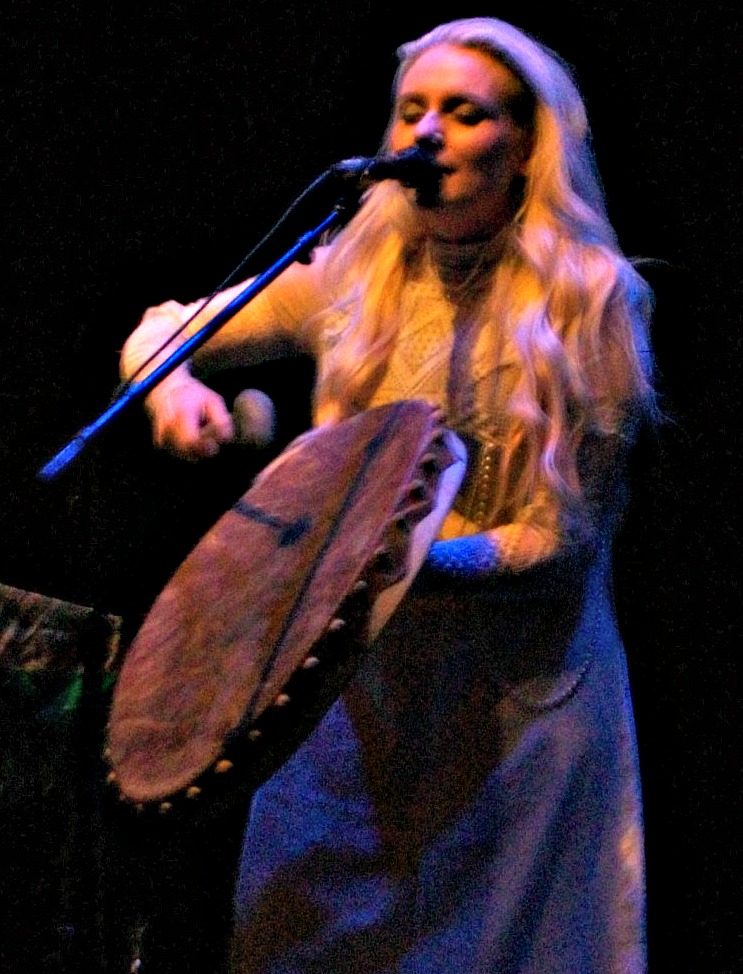
And just as powerful—maybe more so—was her performance of “Trøllabundin,” another of her classic Faroese songs. For this song, her accompanists left the stage, and Eivør had to fill the space with just her voice and a frame drum.
And fill it she did. Part way through the song I realized that I had closed my eyes. Her voice—quiet and mesmerizing, then loud and primal—enchanted me to a place far beyond the city of Washington.
“Falling Free” was the final song. Eivør’s lingering voice hung in my mind like an eternal free-fall long after the song was finished. The concert ended as it had begun—in beauty and pure music.
If you get a chance to attend one of Eivør’s live concerts, I would highly recommend doing so. And put in a good word for me to ask her to come back to the USA sometime, too. I’m sure she gained some more American fans after her D.C. performance!
I love folk music, I love electronic dance music, and I love minority languages. So what could be better than a band that is all three of these things? For my first music review of 2013, I’ll be talking about Buranovskie Babushki, or “The Grannies of Buranovo.”
The eight ladies of the band are all grandmothers, and they hail from the tiny hamlet of Buranovo in Udmurtia, a region in central Russia. Most of their songs are in Udmurt, their local native language, which is actually more closely related to Finnish than it is to Russian.
They rose to international fame in 2010 and again in 2012 when they competed in the Eurovision Song Contest. In 2012, they won the Russian competition, and traveled all the way to Azerbaijan for the final international showdown of Eurovision.
They have two albums under their belts – a self-titled album, and a maxi-single of remixes of their 2012 Eurovision song. Their recent international popularity sometimes seems a sharp contrast to the Grannies’ simple home life and old fashioned values.
At home in Buranovo, they still farm, raise animals, and make clothing the way their ancestors did. They sing their own grandmothers’ traditional songs, and write new songs in the same style as those of old. And then they add a fast techno beat and other sounds of electronica music, and behold—a whole new world of music is born.
Their self-titled album “Buranovskie Babushki – Collection of Songs” is a patchwork quilt of the warbling traditional tunes of the Ural mountains, electronic beats worthy of any dance club DJ, and songs with riveting titles like “Long, long birch bark and how to make an ishon out of it.”
And then, just when you think you’re getting used to this idea of old-world Russian grannies mixing with post-modern techno, they toss in a few cover songs.
Their version of “Yesterday” by The Beatles captured my attention for more than one reason. First off, it’s not every day you hear a group of old ladies singing a Beatles’ song—a capella, no less. Secondly, they translated it into Udmurt. Just a little bit different from Paul McCartney’s original.
This slow haunting song of beautiful melancholy is preceded on the album by the dance song “FooDoora.” At first listen, you might not realize that the same group of ladies had produced both songs, they’re so different. “FooDoora” would be a favorite among any Tiësto-loving club-goer , and then “Yesterday” captures the beauty of the human voice and makes you want to cry, even if you don’t understand Udmurt.
The album opens with their 2012 Eurovision hit “Party for Everybody,” sung partially in English and partially in Udmurt. Ending the album is “Chastushki,” a toe-tapping folk song with a polka rhythm—and of course a nice underlying track of electronica.
If you like folk music, if you like techno, or if you like songs in Udmurt, I would recommend the Grannies of Buranovo. Even if you don’t like any of those things, they are still worth hearing, for their uniqueness if nothing else. How many grandmothers are willing to juggle a rural farm life with international concert touring? Buranovskie Babushki prove that anything is possible, and that you’re never too old to do something new.
Since I love music almost as much as I love books and writing, I’ve decided to do another music review. This time I’m writing about Dobbelis (Beyond), the first release by Norwegian Sami singer Máddji (full name Ánne Máddji Heatta).
Máddji and her music come from Guovdageaidnu (also called Kautokeino), a town in northern Norway. Máddji is a Sami—the indigenous people group of this arctic area. All of the songs on Dobbelis are in her native language of Northern Sami.
Musically, the influences of other famous Sami singers like Mari Boine and Ulla Pirttijärvi can be heard; but Máddji’s songs are not a copy of any of them. She brings a unique amalgam of new age, tribal, and even a hint of jazz to the world of Sami folk and rock music.
Songs like “Cihkosis” (Hidden) and “Guhkki” (Far) have the hypnotic quality of the spoken word to accompany the singing. Equally hypnotic is “Iđitguovssu” (Dawn Light)—Máddji’s clear, breathy voice floats through this trance-like song, punctuated by distant and haunting percussion.
For those who prefer songs with more energy, there’s “Idjarávga” (Night Creature) and “Stállu.” The title song “Dobbelis” (Beyond), while also upbeat, still has Máddji’s voice wandering through like an ethereal wind from her homeland.
Sami yoik—a traditional wordless chanting—dominates much of the album, especially evident in songs like “Báru Luohti” (Yoik of the Waves) and “Ovllá Niillas.”
“Idjarávga” gives Máddji an opportunity to show another aspect of Sami yoik—the mimicking of animal sounds. The imitation of a wolf howling is unmistakable , threading in and out through the background of the song.
I’ve used a lot of tracks from this album as inspiration/mood music for my writing, and I look forward to hearing more from Máddji in the future.
I would highly recommend this album to anyone who is fan of Mari Boine or similar music. And if you haven’t even heard of any Sami musicians but are looking for something new, then Dobbelis might just be the thing for you. Give it a listen!
 StorytellerGirl