Music and Dance and Predictable Plots: Storytelling at its Finest

I love a good story. And whenever I find a good story, whether it’s a book, a movie, a comic, or something else, I often try to analyze it to figure out what it was about the story that made it so good. I’d like to think that this practice has helped me as a writer and storyteller – if I know what makes someone else’s story good, then I can incorporate those techniques into my own writing.

One of my favorite examples to study is the 90s sci-fi TV show Babylon 5, which I have blogged about repeatedly. That is one of the best examples of epic fantasy storytelling, which is my first and biggest love when it comes to stories (to both read/watch and to write). But lately I’ve been absorbing a very different kind of storytelling: the musical comedy movies of the 1930s. 

No epic fantasy tales to be found here in these musical slapstick adventures. In fact, most of these films follow the same basic plot structure and feature the same kinds of characters and story elements or tropes. Original they’re not. So what makes them such good stories? 

Side note: most of the movies I’ve been watching are the films of the Marx Brothers, and the films starring the dance team of Fred Astaire and Ginger Rogers. I know there were plenty of dramatic and non-musical movies made in the 30s, but let’s save a discussion of King Kong or Gone with the Wind for another post.

Romance. This is really nothing new, and certainly not exclusive to the comedies of the 30s. But whether romance was a subplot (like in most of the Marx Brothers movies, since none of them played the romantic leads) or the main plot (as in most of Fred and Ginger’s movies), it’s an ever-present idea. Everyone loves a good love story – it’s one of the oldest and most universal storytelling ideas and it stands the test of time.

Music and dancing. Because, you know, these were musicals. Telling a story through music is also an old and universal idea. Music, like stories, has the power to communicate things about life that ordinary methods can’t match. Also, during this time period most Americans were suffering the effects, great or small, of the Great Depression. A story of happy romance and singing and dancing was more than entertainment – it was a needed respite from a crushing reality.

Archetypal character roles. Complex character development was not really big in these old movies. In fact, you always know the role and basic personality of every main character the moment they show up on screen: the dashing bachelor (Fred Astaire), the career gal with no interest in romance (Ginger Rogers), the crotchety but brilliant con man (Groucho Marx), the inept girl-chasers who wind up saving the day (Chico and Harpo Marx), and so forth. Of course this is largely due to the fact that in these movies I’m discussing, the actors had a “screen persona” that they carried throughout their movies. These stories were never intended to be rich, character-driven explorations of the human condition. The lighter elements of the story were the focus, so little time was spent developing complex characters.

Comedic storyline with predictable plot. Frequently the plot in these movies involved some sort of mistaken identity, with predictable hilarity and unrealistic results. I’m not sure why this was such a common idea, but I can see how this sort of plot would provide the audience with a sense of power, because they knew something the characters didn’t. To the average citizen during the Depression who was at the mercy of uncontrollable circumstances, a brief moment of even fictional power could be very appealing.

Certainly not every good story has to have all (or any) of these elements. But it’s fun to see how these basic elements were used over and over to tell predictable stories that we still enjoy 80 years later.

And now, for your viewing pleasure, here is comedy, romance, and dancing all in one package:
The Color of Creativity

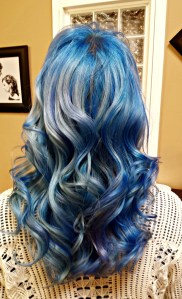
So I recently dyed my hair blue. Actually, my hair stylist did it, and a good thing, too. There’s no way I wanted to have at my own hair with bleach and a tube of dye. Anyone who follows me on Facebook (either my personal profile or my writer’s page) has probably seen a picture or two. So for those of you who haven’t seen me, here’s a picture:

My hair stylist rocks

My hair stylist rocks

The question I’ve gotten the most is, of course, “why?” Some have jokingly muttered about kids these days, and some have asked with genuine surprise and curiosity about what prompted such a radical and dramatic change.

My primary answer is that I thought it would be fun. And that’s true! I wear clothes I enjoy and jewelry I enjoy, so why not do something fun with my hair, too? I feel a bit like a fairy tale creature when I glimpse myself in the mirror, which just adds to the coolness factor. As a fantasy writer, it’s a special kind of fun going around feeling like a character in a story.

After a week of questions, comments, and a few silent disapproving looks, I started wondering if I had some deeper, darker reason for coloring my hair. Was I actually deeply and subconsciously distraught and this was my way of calling out for attention? Was I feeling stifled and blue hair was my way of rebelling? After wrestling with a lot of self-doubt (I’m so talented that I can have self-doubt about lots of other things in addition to my writing!), I concluded that I was not, in fact, mentally disturbed. All I wanted to do was dye my hair blue.

This got me thinking about stereotypes. Not everyone who wears goth makeup, is covered with tattoos and piercings, or has strangely-colored hair is dangerous or disturbed. (Please note – I am not putting down these different styles, and I’m certainly not belittling anyone who dresses a certain way because they’re searching for help.) Yes, the reason that stereotypes develop in the first place is because of the common traits within a grouping. But I know many people who do not fit their stereotyped group, and perhaps now I am one of them.

I colored my hair because I’m creative and artsy, and I decided that it was time for my outward appearance to reflect that. A couple of people expressed to me that with blue hair I would not look professional – which is true if I were trying to fit in the corporate world. But I am a professional writer and social media entrepreneur (or at least working my way towards that), and in that realm, blue hair is just as “professional” as any other color or style.

So maybe I did have a deeper reason for dyeing my hair, after all – to show the world that sometimes negative stereotypes can be wrong, and that blue hair is nothing more than just another color of creativity.

Happy Easter!

Because it’s a holiday week, I’m too lazy to write a real post taking off from blogging this week. Whatever you might be doing to celebrate Easter this week, do it with joy – whether it’s celebrating all the Stations of the Cross, getting the kids photos with the Easter Bunny, or both.

I personally celebrate Easter as a time to remember the sacrifice that Jesus made for me, and a time to rejoice that He’s alive and helping me day by day.

So whatever you’re doing this week – have fun, enjoy your friends and family, and check back next week when I resume my usual bookish and writerly blogging!

Pinterest – the Other Book Site You Should be Using

If you’re a fan of books – whether you’re a writer or just an avid reader – then you probably already have your favorite go-to sites to find new books, participate in discussion or critique forums, or just find writerly advice. Hopefully you leave book reviews on Amazon and GoodReads, and follow hashtags on Twitter like #amreading and #amwriting. But are you using Pinterest?

For those who don’t know, Pinterest is a digital pinboard site where you can collect and share images. People use it for everything from collecting recipes to home decorating ideas to sharing useless snarky memes. None of these are bad, and for sure it all makes Pinterest an entertaining site. But Pinterest can also be used for so much more.

Writers, editors, book reviewers, publishers, and fans can all benefit by using Pinterest in a focused, intentional way. Here are some examples:

A Pinterest Board for your Favorite Books

Why not collect all of your favorite books on Pinterest, just like you collect them on virtual shelves on GoodReads? If you pin a book cover image directly from a legitimate site like Amazon or the author’s own website, then that pin can help you and other people find a copy of that book for reading. You could even go all out and create multiple boards organized by genre or author.

A Pinterest Board for your Current Writing Project or Future Story Ideas

If you’re a writer, then you probably already like perusing the internet for pictures to inspire you. Pinterest is a gold mine for finding inspiration for any sort of project.

pinterest

A Pinterest Board of Writing Tips and Instructional Blogs

There are blogs, articles, and quotes galore about the art of writing. You probably already have some of your favorites that you read regularly. Any post or site with an image is pin-able (unless the site owner specifically requests that their content NOT be shared on Pinterest). Pinterest boards are a great way to collect and organize all of your favorite posts.

Of course there are other ways to use Pinterest to organize your ideas or promote your work. I covered just a few basic ideas here. So now, please share – how do you use Pinterest?

10 More Wonderful Quotes from Oz

I recently compiled a list of ten great quotes from the various Oz stories – everything from Baum’s original tales to the 1939 movie to Wicked the Musical. But I couldn’t stop at just ten. Even if you’re not an Oz buff, I’m sure you can find a witty or meaningful quote in this bunch.


“Everything in life is unusual until you get accustomed to it.” The Scarecrow, from The Marvelous Land of Oz

Says the man made of burlap and straw. Point taken. Different isn’t bad – it’s just different.OzHat


“So much of me is made from what I learned from you. You’ll be with me, like a handprint on my heart.” Elphaba, from Wicked the Musical

This is one of the best quotes about friendship I’ve ever come across, and reminds us that a love story does not have to be about sex and romance.


“But in Oz we are loved for ourselves alone, and for our kindness to one another, and for our good deeds.” Princess Ozma, from The Road to Oz

Even in Oz society is not always as perfect as Ozma claims here, but to her credit, this is a creed that she herself lives by and employs as she rules her people. And here on earth we’d do well to keep this attitude more in our daily lives.


“Nothing’s impossible if you just put your mind to it.” Oz, from Oz the Great and Powerful

Just remember that if a small-town circus performer could defeat two wicked witches with this attitude, then you can do anything.


“The only way to do a thing
Is do it when you can,
And do it cheerfully, and sing
And work and think and plan.
The only really unhappy one
Is he who dares to shirk;
The only really happy one
Is he who cares to work.”
Johnny Dooit, from The Road to Oz

This little rhyme speaks the truth for itself, I think.


“A heart is not judged by how much you love, but by how much you are loved by others.” The Wizard, from The Wizard of Oz

This is so true. And one who is deeply loved usually can’t help but love in return.


“No one can be unlucky who has the intelligence to direct his own actions.” Scraps, from The Patchwork Girl of Oz

The stuffed patchwork doll named Scraps displays almost Scarecrow-level wisdom with this statement. Even in the most unfortunate of circumstances, we still have free will and can make choices.


“We get up at noon and start to work at one. Take an hour for lunch and then at two we’re done. Jolly good fun!” The citizens of Emerald City, from The Wizard of Oz

This is my kind of workday. Can I live here? This line is from the song “The Merry Old Land of Oz”; so if you’ve seen the movie, you now have that song in your head. You’re welcome.


“But those as knows the least have a habit of thinkin’ they know all there is to know, while them as knows the most admits what a turr’ble big world this is.” Cap’n Bill, from The Scarecrow of Oz

Sad but true. I’m sure we’ve all met an ignorant know-it-all or two.


“He had nine book-trees, on which grew a choice selection of story-books. …the books were picked and husked and ready to read. If they were picked too soon, the stories were found to be confused and uninteresting and the spelling bad. However, if allowed to ripen perfectly, the stories were fine reading and the spelling and grammar excellent.” from Tik-Tok of Oz

I love the magical land that Baum invented, where most anything you could want probably grows on a tree somewhere. I also love Baum’s not-so-subtle hint to aspiring authors everywhere: if you pick (publish) your book too soon, without giving it time to ripen (with rewriting, revising, and editorial help), then most readers will be confused, bored, or just get bogged down in grammatical errors.

Bonus quote:

“Eleka nahmen nahmen ah tum ah tum eleka nahmen.” Elphaba, from Wicked the Musical

I put this in here to be funny, because nobody knows what this means. And if you’ve seen Wicked, then you are now singing the song “No Good Deed.” You’re welcome.