A Mother’s Day tribute to Great Moms of Literature

Mother’s Day is this coming Sunday, so I thought I’d devote this post to some of the great moms in books. I have a wonderful mother, as I’m sure you do, too. But here are my top five favorite fictional mothers.

5. Mrs. Rabbit, from Peter Rabbit, by Beatrix Potter

Poor patient Mrs. Rabbit, who had a son who always did exactly what she told him not to do, and lost his shoes and his jacket repeatedly. Even so, she didn’t punish him harshly—she just put him to bed with some chamomile tea. For all the headaches Peter gave her, she stayed a gentle and loving mom.

4. Missis, from The Hundred and One Dalmatians, by Dodie Smith

Sure, we all loved Perdita in Disney’s various film versions of this story, but I’m talking about the original. In the book, Perdita was a different dog—Missis was Pongo’s wife. First off, she gave birth to fifteen puppies. Props to her for that alone. Then, when the puppies were kidnapped, Missis risked her life facing the wild outdoors and Cruella De Vil to get her kids back. And she wound up being a mother to 97 puppies by the time it was all over. Now that’s a mom.

3. Leia Organa-Solo, from The Thrawn Trilogy, by Timothy Zahn

There are hundreds of post- Return of the Jedi stories out there, but the ones I have in mind are the Thrawn Trilogy, which basically launched the Star Wars multi-media franchise back in the 90s. In this story, Leia gave birth to her twins Jacen and Jaina Solo. She dealt with all the joys and struggles of raising two infants while traipsing around the galaxy, rescuing Luke, fighting off the remnants of the Empire, and holding a government post in the New Republic. A true super-mom.

2. Molly Weasley, from the Harry Potter series, by J.K. Rowling

Molly raised a herd of wild red-headed kids, and managed to keep a lid on things despite those kids doing things like quitting school to open a magic shop and flying their father’s car into a Whomping Willow. But she still had enough love to all but adopt Harry into her family, and she had enough ferocity to take out some Death Eaters and Bellatrix Lestrange. Another super-mom.

1. Marmie, from Little Women, by Louisa May Alcott

Meg, Jo, Beth, and Amy lovingly called their mother “Marmie” when they were young, and as they grew up, Marmie stayed central to their lives. Through marriages, births, deaths, career struggles, and the general pains of growing up, Marmie kept her family together. She encouraged her daughters’ creativity and independence, wasn’t afraid of disciplining them, taught them how to be loving by showing kindness to strangers and neighbors alike, and stayed strong while her husband was away at war. Marmie was just an all-around awesome mom.

Any other literary mothers you’d like to add to this list? And don’t forget to wish your mom a happy mother’s day!

Where do you get your ideas?

Speaking just for myself, I’ve always found it odd when someone asks me where I get my ideas. I get my ideas from everywhere, from life all around me. A song, a conversation with a friend, a scene in a movie, a picture on the wall, a tree, my pet rabbits, a rumpled pillow on a sofa… Anything and everything is fodder for ideas.

For me, ideas—whether they be plot ideas, character ideas, or something more ephemeral—hit me at random times, from any sort of random prompt. I’ve got a notebook full of story ideas. So I have never really had the problem of thinking “I want to write, but I don’t know what to write about.”

Even so, I often feel uninspired, and sometimes a writing prompt of some sort can help jumpstart me back into the process. My primary go-to writing prompt is music of some sort, but pictures often help, too. So here are some pictures that can perhaps help you to jump-start those creative thoughts.

A pen and a notebook. What will you write?

A pen and a notebook. What will you write?

Something's about to happen here...

Something’s about to happen here…

What a cute wee door! Who lives here?

What a cute wee door! Who lives here?

A lone man and a great wide view. What does he see?

A lone man and a great wide view. What does he see?

Funny name for a train platform...oh, wait, some other author already used this one...

Funny name for a train platform…oh, wait, some other author already used this one…

What song is he playing?

What song is he playing?

Tree creature

Tree creature

There's gotta be a good story behind this one!

There’s gotta be a good story behind this one!

What kind of stories did these pictures prompt for you? Please share in the comments, or even share a link to your web page where you’ve posted your ideas!

(Feel free to copy or repost these pictures, but PLEASE give me credit by linking back to this blog. That’s not only the properly legal thing to do, since I took all of these pictures, but it’s also the ethical thing to do. And the law and ethics so rarely coincide these days!)

Music Review: “In the Silence,” Greta Salóme Stefánsdóttir

There’s a lot of musical talent in Iceland, and frankly, the rest of the world needs to know about it. Greta Salóme is a young Icelandic musician who just released her debut album, In the Silence (released in 2012 by Hands Up Music). Greta began her career as a classically-trained violinist and still performs with the Icelandic Symphony Orchestra.  But on this album she displays other talents, as well—composing, lyric-writing, and singing.

Most of the songs (written and composed by Greta) are in English. “Mundu Eftir Mér” and “Aldrei Sleppir Mér” are the two Icelandic songs on the album.

The song “Never Forget” helped to gain her international recognition as it was Iceland’s official entry for the Eurovision Song Contest in 2012. She sings a duet with Icelandic music star Jonsi (real name Jón Jósep Snæbjörnsson).

Folk, rock, and even dance styles are featured on this album—punctuated throughout by Greta’s violin, especially evident in tracks like “These Last Days of Summer,” “See you There,” and “Never Forget.”

For those who want an easy folk-rock sound, there are songs like “Take this Empty Heart” and “Coming Home Soon.” For a faster beat and more of a rock or dance feel, try “In the Silence” and “Everywhere Around Me.”

Greta’s clear, powerful voice shines in every song. “A Thousand More Goodbyes” is a beautiful showcase for her voice alone and the simplicity of the arrangement can make you want to fall in love just by hearing it. And her voice is not diminished in the slightest by sharing the music with Jonsi in “Never Forget,” and “Mundu Eftir Mér,” the Icelandic version of the song.

All of Greta’s lyrics speak of love, life, and hope. Personally, I enjoy songs that are positive in their words, even if it’s a song of sorrow or pain. “We Are” and “Everywhere Around Me” are songs that just make me feel good. And a song that makes me feel good, I’ll listen to again and again.

For anyone who wants some new music with some musical and even linguistic variety, I’d recommend this album. Greta’s first releases were a couple of singles (“Vor” and “Bethlehem”—not on this album) and I’m looking forward to more singles and more albums from her. Here’s to bringing more Icelandic music to the world!

Greta Salóme’s Facebook page

“Never Forget”

Music Review: Live Concert – Eivør

I’ve written several music reviews on this blog, and I think I might like to make a habit of reviewing live shows, as well. For that to happen on a regular basis, I’d need to either travel more to find my favorite bands (that would be awesome), or have them come closer to me (that would also be awesome).

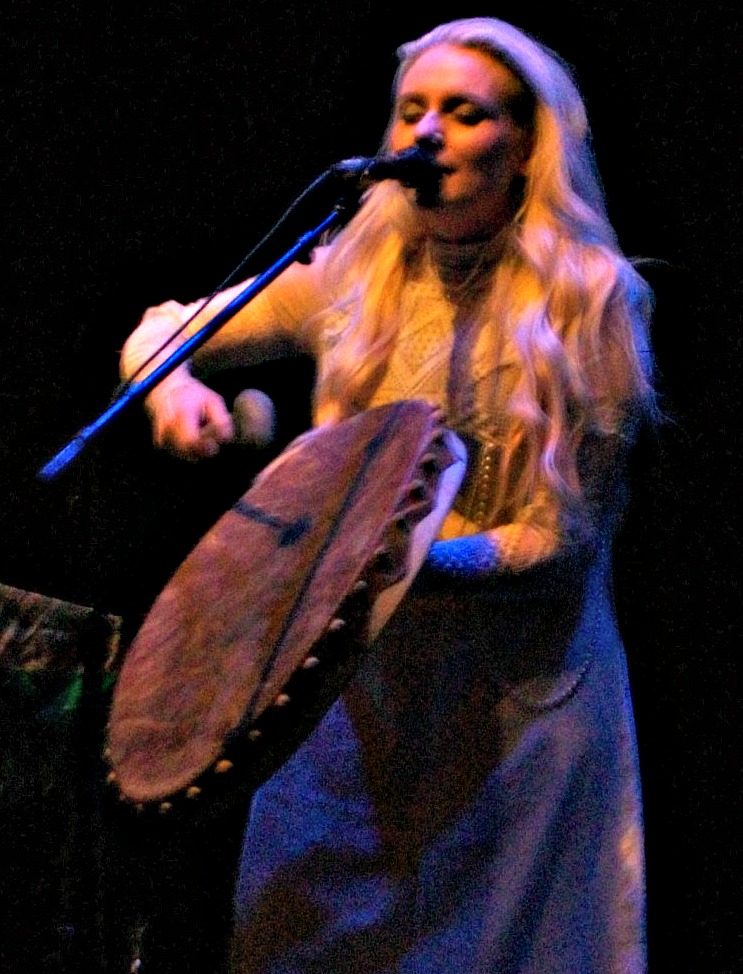
This past week, one of my favorite singers did indeed come to me. Faroese singer/songwriter Eivør performed in Washington, D.C. as part of a Nordic exhibition at the Kennedy Center for the Performing Arts. (I reviewed Eivør’s most recent album Room a few months ago).

The concert began gently, as Eivør came onto stage alone—barefoot, wearing white, and silent. She began with the Faroese lullaby “Rura Barnið,” played on the kalimba (thumb piano). The bell-like tones of the thumb piano transitioned seamlessly into the musical intro to “Green Garden.”

Songs from her latest album Room was the theme of the show—she sang “Boxes,” “True Love,” “Eg Veit,” and others. “Rain” was one of my favorites from this concert. Before beginning the song, Eivør announced that she was going to try something she’d never done before, and laughingly apologized in advance if it didn’t work.

The audience sat alert in anticipation as she adjusted the microphone on her mandolin, and then bent over the instrument and sang into it. Using the mandolin’s mic to capture the wailing chant that is the intro to “Rain” was a success, and after a delighted grin to the audience, Eivør played back the track and launched into the song.

I wish I’d been fast enough with my camera to capture that moment. Most musicians sing with their instruments—but leave it to Eivør to take music to a new level of unique by singing to her instrument.

The gentle Nordic fairy that is Eivør on stage disappeared briefly during songs like “Nu Brenner Tu I Mær.” Suddenly she was an angry Viking goddess, full of power and passion.

And just as powerful—maybe more so—was her performance of “Trøllabundin,” another of her classic Faroese songs. For this song, her accompanists left the stage, and Eivør had to fill the space with just her voice and a frame drum.

And fill it she did. Part way through the song I realized that I had closed my eyes. Her voice—quiet and mesmerizing, then loud and primal—enchanted me to a place far beyond the city of Washington.

“Falling Free” was the final song. Eivør’s lingering voice hung in my mind like an eternal free-fall long after the song was finished. The concert ended as it had begun—in beauty and pure music.

If you get a chance to attend one of Eivør’s live concerts, I would highly recommend doing so. And put in a good word for me to ask her to come back to the USA sometime, too. I’m sure she gained some more American fans after her D.C. performance!

Eivør’s website: www.eivor.com

Kennedy Center Feb 046

THE NEXT BIG THING – Blog Hop

I did a blog hop about the Next Big Thing once before, but I thought it’d be fun to give it another go. I will be answering several questions about my WIP. In the first “interview” about the Next Big Thing, I talked about the second book of the trilogy I’m doing, because I’m currently writing the first draft of it. For this blog “interview,” I’ll talk about the first book, which is in the rewrite and first round of edits stage.

1: What is the working title of your book?  

The Vanished Reindeer. The trilogy is titled The Light-Whisperers of Kalevala.

2: Where did the idea come from for the book?

I wrote a blog post once specifically about that. The idea came from a thought about a herd of reindeer and a mystery—and to solve the mystery for myself, I turned to the realm of fantasy.

3. What genre does your book come under?

Fantasy. Specifically, cross-world fantasy (where the story takes place both on earth and in a fantasy world), with a dose of mythology-inspired fantasy.

4: Which actors would you choose to play your characters in a movie rendition?

Dunno. I’m still working on this one. Most of the actors would need to be Finnish, as the story is set in Finland and only one of the characters is American.

5: How long did it take you to write the first draft of your manuscript?

About a year and half to finish the first draft.

6: What else about your book might pique the reader’s interest?

Well, let’s see—are you a reader who likes fantasy that pulls elements from mythology and classic literature? Are you a reader who likes a good Scandinavian mystery? Are you a reader who likes mysterious monsters, immortal queens, magic, music, and just a dab of romance? My book has all of that—hopefully tied together in a nice cohesive package. That’s what this rewriting/editing phase is for.

Many thanks to Bonnie Watson for sending me this blog hop entry. Check out her books at www.WisdomNovels.com!