So What About Maps in Novels?

I like maps. To me, a map adds a level of realism to a place, cementing it in my mind in a unique way—even if it’s a map of a place that I already know well.

I don’t often drive with a GPS. Usually (but not always), if I can study a map of the route ahead of time, and maybe have written down a couple of landmarks like a noteworthy building or an exit number, I’m good to go. And once I’ve driven or walked a route two or three times, I pretty much have a map of it in my head.

For me, maps in books serve the same function. The map adds a dimension to the places in the book, and helps to frame the characters as they interact within that space. I’ve read a few blog posts about maps in novels (if I could remember which blogs, I’d link to them). There seems to be a bit of a divide as to whether people like maps in their novels or think them unnecessary fluff. Apparently, there are some literary critics who consider a map to be a “crutch” of sorts, useful only to writers who can’t convey setting properly or to readers with no imagination.

Personally, I’ve never encountered anyone who thought that way. But if you are of that opinion of maps in books, then I do apologize if I offended. No offense is meant towards anyone—this blog is, quite obviously, my own opinion; feel free to stop reading at this point, if you so desire.

For those who have kept on reading, I will continue to express my opinion and my love of maps. Yes, I’m partial to maps in books because I’m a lover of fantasy stories—and fantasy, more so than most other genres, lends itself to needing maps because the location is a place that absolutely no one (besides the author) is already familiar with.

If you’ve read any of Tolkien’s stuff, you were probably glad to have a map so that you could track Frodo’s journey across Middle-Earth, and find out where Minas Tirith and Minas Morgul actually were in relation to each other.

Or, take the Bone series by Jeff Smith (yes, I know this is technically a graphic novel—more on that in another post). A map, as drawn by one of the characters, is a very important plot point, in addition to the map helping the reader to understand the importance of the fact that Barrelhaven is nowhere near The Dragon’s Stair.

Maps don’t have to be relegated to fantasy, certainly. Most any story that involves traveling in some fashion, or that takes place in a distant or little-known place can at least be enhanced by a map. In Andrea Barrett’s The Voyage of the Narwhal, there is a detailed map of the west coast of Greenland and all of the nearby islands in the Canadian arctic. The book is a historical fiction tale about a sailing ship that travels through the dangerous waters of the high arctic; not the most well-known part of the world, especially when the 19th century names for places are used, so a map helps.

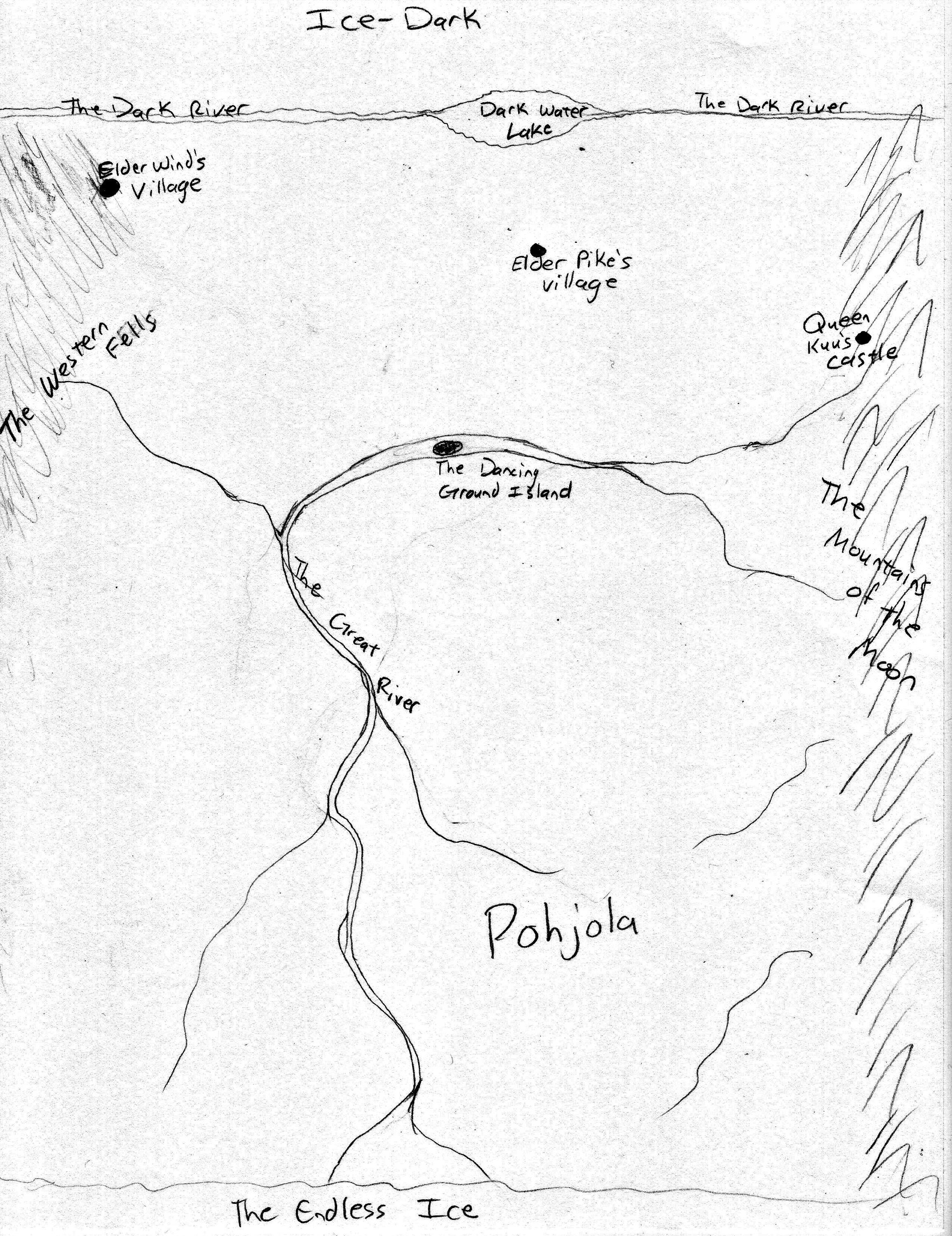
And so, since I’ve been singing the praises of maps this whole time, it seems only fair that I should provide one of my own maps. I’m not an artist, or a cartographer, and so I may have to engage the help of some skilled person for the final version—but here is a rough map of the land of Pohjola. The characters actually spend a good portion of the book traveling, so I quickly realized that some of my readers might appreciate a map. And even though I had the map of their journey all vivid in my head, it helped me to have it drawn out.
I’d love to hear your thoughts! Any other map lovers out there? Map-haters?

Comments, tweets, and Facebook posts are welcome. 🙂

The Land of Familiar

I was at a leadership conference recently, and one of the speakers was talking about stepping out of the land of familiar.

The land of familiar is a great place—it’s different for each person, but it’s comfortable, it’s home. There’s nothing wrong with familiar. It’s a place that gives us stability in our lives, that shapes our world-view. Loved ones are there.

But just like how a baby had to leave the comfortable, familiar arms of mommy and daddy and takes steps on its own in order to walk, we have to leave the land of familiar if we are going to accomplish something new in life.

It doesn’t have to be something grandiose. But as the saying goes, if nothing changes, then nothing changes. And while the land of familiar is a great place to be, it kind of gets to be the same after a while. Familiar.

I’m not trying to give life lessons or success principles here (even though I kind of am, I guess). But as I was learning from this speaker about how to succeed in life, I realized that it applies to writing, too. Writing is, after all, a form and extension of life, isn’t it?

If you want to try a writing exercise, maybe try stepping out of the land of familiar, even just for a little while. Are you a fiction writer? Try cranking out a poem. Do you have a well-polished piece that you’ve never let anyone read? Let a trusted friend give you some feedback. Do you always write in the first person? The third person perspective might give you some new insights into a character.

For me, this blog is a big giant step out of the land of familiar. I’ve never shared any of my writings with more than a few people close to me, and now my words are floating across cyberspace, available for several billion people to stumble across and read. And I’m also putting writing tips and advice into some of my blogs—being in a teacher/instructor sort of role, even via a blog, is a bit out of my realm of comfort.

I’d love to hear your thoughts! Have you stepped out of the land of familiar today?

The First Sentence

Today’s blog subject I’m totally stealing from one of my favorite blogs that I read. Ava Jae wrote a great post on her Writability blog about great first lines of books.

So to continue on that thread, I decided to write about my take on the first sentence of a story.  What makes a good beginning to a novel or story anyway?

1. The first line should be attention-getting. It’s “the hook,” as folks in the writing world like to call it. A good example of an attention-getting first line can be found in the novel The Third Witch by Rebecca Reisert:

                “’Tis time to rob the dead.”

First of all, it’s a line of dialogue, so it puts the reader right into the middle of something happening. For me, I want to read on to find out who is talking, who they are talking to, and why.

Secondly, it’s a bit shocking. Grave-robbing is not generally something that’s done or even talked about in polite society. Immediately the reader is jolted awake (just in case they’d dozed off somewhere between the cover and the first page).  Not every first sentence needs to be this startling and grisly, but a hook of some sort is a good way to begin a novel.

2. The first line should involve the main character. The MC doesn’t have to be in the first sentence, or even the second or third sentence, but it’s a good idea if the beginning lines point to the MC somehow. As a reader, I, for one, want a story that’s about a character, not just a retelling of a Wikipedia entry.

Here’s a first line that introduces one of the main characters. It’s from C.S. Lewis’ The Voyage of the Dawn Treader, my favorite book from the Chronicles of Narnia.

                There was a boy called Eustace Clarence Scrubb, and he almost deserved it.

What a humorous—and attention-getting—intro to the book and the character! Right away, Lewis incites both dislike and pity for Eustace, as well as piquing curiosity as to the specifics of why he deserved such a name.

3. The first line shouldn’t be about the weather. I know I’ve read this tip in multiple places, and if I could find the blogs or remember who might have tweeted it, I’d include them here.

Weather (or descriptions of the setting or environment) is certainly important, but so easily it could become the Wikipedia entry that I mentioned earlier. Some sense of setting is good, but we all remember the classic no-no of beginning a story with “It was a dark and stormy night.”

The Voyage of the Narwhal by Andrea Barrett (oddly, I’m using two books about sea-going boats in my examples) has a good first line that involves a mention of the setting and weather, but also has the main character and a hook.

                He was standing on the wharf, peering down at the Delaware River while the sun beat on his shoulders.

So we know it’s a sunny day by a river. But more importantly, it involves the main character, and it leads the reader to wonder why he’s on the wharf and why it’s the Delaware River specifically, and thus read on.

And now, for a final example of a first sentence, here is the first line of the fantasy novel that I’m currently working on:

                It was barely dawn when Lyylia Niiranen hauled her suitcase out of the trunk of the taxi cab.

I’m not claiming that this is the best first line ever, especially according to the criteria I just laid out, and the other examples. But I would be interested in some feedback. Does my first line grab your attention at all? Does it make you want to give the next sentence a chance, or are you already underwhelmed? What are some of your favorite first lines?

Comments are welcome!

3 Reasons Why I Love Beatrix Potter

A few days ago I re-watched one of my favorite movies of all time—Miss Potter. In case you haven’t seen it, the film is a reasonably accurate portrayal of a span of several years in the life of Beatrix Potter. It covers her journey from a single woman bored with life with her parents and their pretentions at aristocracy to her life as a published author and wealthy community leader. The film stars Reneé Zellweger and Ewan McGregor (that should be reason enough to see it, with that line-up…)

Number 1: I love Beatrix Potter because she wrote some awesome stories. For a hundred years now, children have read and loved the stories about Peter Rabbit, Tom Kitten, Mrs. Tiggy-Winkle, and all the rest.

One of my personal favorites was The Roly-Poly Pudding (or The Tale of Samuel Whiskers, depending on the edition). There was something about that story that was creepy but fun, like ghost stories around a campfire. In the story it was chillingly cool that the house was so big that Tom Kitten could get lost for days before anyone might find him and that the walls were three feet thick.

In reality, if I lived in a house where I could hear dancing and partying inside the walls, and there were rats big enough to run off with things like rolling pins, I’d move. But Beatrix Potter turned it into an adventure story, complete with the thinly-veiled moral of “always obey your mother.”

Number 2: I love Beatrix Potter because her life inspired the Miss Potter movie. Did I mention that this movie is one of my all-time favorites?

One of the things I love most about the movie is the way that the director brings the audience not just into Beatrix’s life, but into her creative process and into her mind. There are little moments—just a few, and very subtle—when Beatrix’s drawings come to life and respond to her. These moments are not long or overt and don’t interfere with the stodgy Victorian setting—they’re just little animated tweaks that let the viewer know how deeply Beatrix was involved with her characters and art. How real they were to her.

As a writer, I can readily identify with this concept. My characters are my friends; I enjoy spending time with them, and sometimes we even argue. For example, right now one of my characters (Teija is her name, and she’s normally a somewhat timid girl) is loudly banging on my mind to remind me that I left her last scene hanging much too long ago and when am I going to finish it already.

There’s a scene in Miss Potter when Beatrix is trying to cope with a sudden tragedy in her life and she stays up all night sketching—only to have her beloved Peter turn away from her as she’s drawing. Peter Rabbit, frightened by his creator’s sadness and anger, flees from her, running away through the various drawings scattered across her desk.

The pencil sketch of Peter Rabbit hides behind some flower pots in one drawing and peer out at her, as if to give her firm instructions: “don’t you dare try to paint me or tell my story until you’re in a better frame of mind.” Peter may be a troublemaker of a little bunny most of the time, but in that instance, he is giving his creator some sorely-needed guidance.

Any other writers or artists out there besides me and the movie Beatrix who have experienced this? Have you ever felt guided (or even pushed) by your characters, instead of the other way around?

Number 3: I love Beatrix Potter because she achieved every writer’s dream. No, not every author or artist wants to live on a farm in the country raising sheep, but she did that because she loved it and she was making enough money with her books to live the lifestyle that she wanted. Control over their own life is every person’s dream to one extent or another, I believe. Not everyone will achieve this dream—and not every writer will get rich with their books—but the way I see it, if even one person did it, then there’s a chance that someone else can, too.

Beatrix Potter not only gained control of her lifestyle with her books, but she accomplished what is perhaps an even deeper universal dream—she created a legacy. She wrote something worth reading long after she was gone. More than 50 years after her death, and her stories and drawings are still bringing joy to children everywhere.

I’d love to hear your thoughts! Any other fans of Beatrix Potter out there? What author’s life story has inspired you?

peterrabbit_group_800

Some legal disclaimers, just in case…

Frederick Warne and Co owns all rights and copyrights to Beatrix Potter’s works

Miss Potter, 2006 by Phoenix Pictures, directed by Chris Noonan

Blogging like a pro, here we come…

So, here I am, starting up a blog!

This should be interesting.  While I’m not one to shy away from writing something or anything, having my writing/musings/journal entries out on display for the world to see is a bit overwhelming. It’s like a really long, in-depth Facebook update…

My plan is to blog periodically (hopefully once or twice a week, but we’ll see) about my writing habits, my reading habits, my research habits, my music-listening habits, and perhaps the occasional adventure with my pet rabbits.

So stay tuned…!