Happy Valentine’s Day from a Few Fictional Couples

To celebrate Valentine’s Day, here is a brief post about romance. I’m not a reader or writer of the romance genre, but I like a good love story as much as the next gal. So here are four of my favorite couples from sci-fi and fantasy.

Éowyn and Faramir – Lord of the Rings

I could have picked Arwen and Aragorn from this series, but I actually like the story of Éowyn and Faramir’s relationship better. There’s less romance, since they don’t actually get together till the very end, but I like how these two tragic characters who have faced death and lost loved ones find healing and joy with one another. And their union helps to re-forge the ties between the kingdoms of Rohan and Gondor, so that’s always a plus, too.

Helen Rossi and Paul – The Historian

This couple is from a book that I recently read called The Historian. (I discussed this book briefly in another post here). These two people wind up together on an unexpected quest to find a common loved one who’s gone missing (Paul’s professor, who is also Helen’s father). Since the story is told in the first person by Paul, we get only his feelings for Helen, but the author did a beautiful job of showing Helen’s growing affection for Paul even without getting the reader into her head. Although the actual “love scenes” in this book are minimal, the characters’ passion for each other is evident on every page.

Gomez and Morticia Addams – The Addams Family

I mentioned the Addams family and love in another recent post. Gomez and Morticia are well known for their propensity to drop whatever they’re doing at any random moment and engage in a passionate encounter. But in addition to their chemistry and sweet murmurings in French, they have a solid, deep love that is never shaken by external or internal conflicts. They are a together-together couple who raises their family with strong (albeit bizarre) values, and they show unconditional love to everyone in their family.

John Sheridan and Delenn – Babylon 5

This pair is probably my favorite fictional couple ever. There’s a lot to say about these characters and the way that their relationship is written into the story. Their romance grows slowly and naturally – it takes a year and a half before they begin to realize their feelings for each other. They’re from different races (which used to be at war) and so the cultural tensions are always subtly present, even after they’ve been married for years. I also like how these two stay happily married, even through the rough spots, and they always make decisions together as a couple. (Short-term romances seem to be very popular in TV shows, and almost expected in sci-fi TV shows, after the precedent set by Captain Kirk in classic Star Trek.) Also, all of the other characters (well, most of them) love Sheridan and Delenn as a couple, and are constantly supportive of their relationship. Their goodbye to one another at the end of the series is one of the most poignant partings ever (can anyone watch the finale “Sleeping in Light” without crying?)
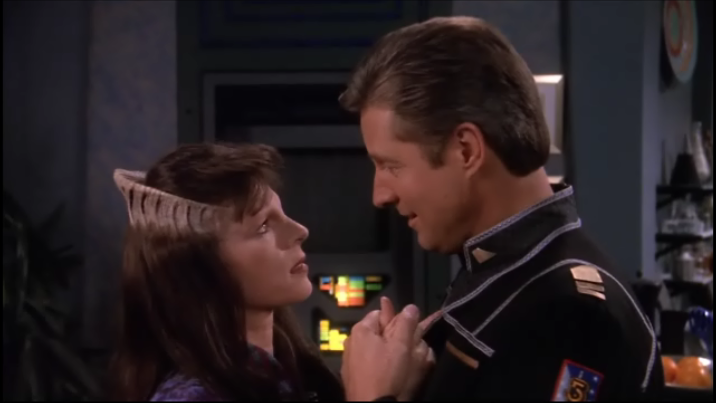
Delenn and Sheridan, from "Babylon 5"

Delenn and Sheridan, from “Babylon 5”

So who’s your favorite fictional couple? Please share!

10 Wonderful Quotes from Oz

If you know me, then you know that I’ve always been a big fan of the Oz stories. I’ve seen the 1939 movie more times than I’ve seen the original Star Wars trilogy (if such a thing is possible). I love the two (different but equally awesome) prequel stories Oz the Great and Powerful and Wicked (the musical. I haven’t read the book yet. Yes, I know they’re rather different).

I’ve also been working my way through L. Frank Baum’s original books. You can see a recent post I wrote about that here. As I’ve been exploring the Land of Oz, I’ve started collecting some great quotes. So here are ten of my favorite quotes (so far, since I’m only on book 6 of Baum’s original 14) from books, movies, and shows.

“Some people without brains do an awful lot of talking, don’t they?” The Scarecrow, from The Wizard of Oz

This is one of the most famous quotes of the Scarecrow, and possibly one of the most well-known quotes from the entire movie (with the exception of “Fly, my pretties!” and “There’s no place like home.”) Apparently the Land of Oz has its share of morons who won’t be quiet, too, just like earth.


Oz: “You want me to lead an army that can’t kill?”

Glinda: “If this was easy, we wouldn’t need a wizard.”

from Oz the Great and Powerful

Poor Oz. There’s really nothing he can say to this. At this point he’s really wishing his balloon had never left Kansas.


“When music is not very good, and is indulged in all the time, it is better that the performer should be alone.” Princess Ozma, from The Road to Oz

I love Ozma’s polite, stinging slap to obnoxious people everywhere. I need her in the car with me at traffic lights, so she can roll down the window and say this to the guy next to me who has the bass cranked so loud that it can be heard all the way to Oz.


Fiyero: “You think I’m really stupid, don’t you?”

Elphaba: “No, not really stupid.”

from Wicked the Musical

Elphaba, the master of the back-handed compliment. Love it.


Elmira Gulch: “I’m here to see Dorothy about the bite on my leg.”

Uncle Henry: “You mean she bit ya?”

Elmira Gulch: “No, her dog.”

Uncle Henry: “Oh, she bit her dog, eh?”

from The Wizard of Oz

God bless acerbic, long-suffering Uncle Henry. This is one of my favorite dialogue exchanges in the whole movie.


“I’ve been lost before, and always got found again.” Dorothy, from The Road to Oz

The beautiful logic of a child. Baum did a good job in his books of portraying Dorothy with the emotional maturity of an adult so she could remain clear-headed during her various adventures, while still maintaining the imagination and purity of a child.


“Some things I cannot change, but till I try, I’ll never know.” Elphaba, from Wicked the Musical

Elphaba is never afraid of trying or pushing the envelope, and we never should be, either.


“I am convinced that the only people worthy of consideration in this world are the unusual ones. For the common folks are like the leaves of a tree, and live and die unnoticed.” The Scarecrow, from The Marvelous Land of Oz

More wisdom from the Scarecrow.


“You’re capable of more than you know.” Glinda, from Oz the Great and Powerful

Glinda’s encouragement to the Wizard is really an encouragement to all of us.


“In this world in which we live simplicity and kindness are the only magic wands that work wonders…” from The Emerald City of Oz

Baum may have been a writer of fairy tales, but he understood the truth.

Fantasy Characters as Role Models

Finding role models in fiction is not a new concept (or even a new idea for a blog post, probably). But I’ve been thinking and reading lately about characters, how to write them, and what they can mean to readers. So here’s a short list of some of my favorite characters from fantasy and science fiction, and what they can teach us about how to live and how to behave.

Sam Gamgee from The Lord of the Rings Loyalty

Let’s start with everyone’s favorite Hobbit sidekick. Except he’s more than just a sidekick. He’s more than a gardener, a bodyguard, or even a good friend. He’s a man so loyal to his friend and to his own word that he faces off against orcs, a giant spider, and a raging volcano just because he told Gandalf that he’d protect Frodo. His word is his bond, no matter what.

Hermione Granger from the Harry Potter series – Courage 

Hermione can be described in many ways: smart, clever, nerdy, loyal. But really, none of these traits would enable her to accomplish half of what she does if she weren’t exceptionally courageous. Courage isn’t the absence of fear – it’s feeling the fear and doing what you need to do anyway. From the first book on, Hermione bravely steps out to help save the day, never letting fear of Voldemort – or worse, expulsion from Hogwarts – stop her from doing what she knows is right.

John Sheridan from Babylon 5 – Justice

Captain Sheridan is the perfect leader for the Babylon 5 space station – he’s brave, smart, and a true warrior. All of this stems from his fierce sense of justice. When faced with the tough decisions of life, the ones with no clear-cut right or wrong, he uses his sense of justice and fairness to temper his decisions. He lives by the understanding that every decision – good or bad – comes with consequences. Whether others label him as a hero or a villain, he stays true to his principles of justice and personal responsibility.

Fezzik from The Princess Bride – Honesty

Fezzik the gentle giant is kind, patient, and maybe a little slow, but he’s the most honest character in the story. While he never directly rebels against Vizzini, his honesty prevents him from carrying out his malicious orders to kill Westley. He’s intensely loyal to his friend Inigo, and once he determines that Buttercup and Westley are the good guys, he never stops supporting them because he believes in rightness and honesty.

Princess Anna from Frozen – Compassion

Anna is brave, eternally optimistic, and loves her sister dearly. But really, her greatest role model-worthy trait is compassion. Her love for Elsa is more than just a sister bond. Despite her shock and confusion when Elsa reveals her powers, Anna immediately understands how Elsa must be feeling. Her ability to empathize with Elsa’s fear and loneliness is what drives her to literally freeze to death for her sister’s sake.

The Scarecrow from The Wizard of Oz – Wisdom

The Scarecrow is the smart one without any brains, but he’s also very wise, which is a different sort of intelligence. Wisdom such as knowing when to take charge – which he does for most of the story – and when to let someone else lead (by telling the Lion that he’s the one to lead them into the Wicked Witch’s castle, or by submitting to Glinda’s authority at the end of the movie). Wisdom tells him to trust this strange girl and her little dog. The intelligence of knowing the Pythagorean theorem is less important in life than making wise decisions.

The Addams Family – Love

From the movies to the classic TV show to the original cartoons by Charles Addams, Gomez and Morticia Addams have represented the ultimate in passion and romance. But there’s more to love than romance. Love means sticking together no matter what storm is raging, or standing up for a loved one who might be acting very unlovable. This family may have dead flowers as the centerpiece and a loose hand that runs around the house, but they have love. No outside force or inner turmoil pits Gomez and Morticia against each other, or draws their children away. Even Uncle Fester’s poor decisions can’t make the others turn their backs on him. Any family that wants to stay strong should put as much of an emphasis on love as the Addams do.

Yes, I know that this is a really short list. I could have listed several hundred characters, and made this post longer than the epic fantasy trilogy I’m working on, so I had to pare it down somehow. If you have a favorite fantasy character that has positive role model traits, feel free to share in the comments!

Worldbuilding: The Why before the How

I’ve written several posts about world building for fantasy and sci-fi, but on this post I want to come at it from a slightly different angle. What’s more important than the how-to of putting together a new society or creating an alien race is why. Why do you want an alien species that can live on the surface of a sun? Why do you want steampunk airships powered by magic spells instead of gas or steam?

The coolness factor aside, what I’m talking about is getting you to look at the bones of your story and your world. Cultural habits, societal structures, technology and industry, animals both wild and domesticated – all of these elements of life are the way they are for a reason. It may not always seem logical or even right – like in the case of a society’s sense of fashion – but it still fits within the context of the larger world as a whole.

For example, in The Chronicles of Narnia, the Talking Beasts are more than just cute anthropomorphized animals to make the story appealing to children. Even if they originally started out that way, C.S. Lewis develops the Talking Beasts into their own culture. The reason for the existence of this fantasy culture is revealed throughout the stories. In Prince Caspian, the children encounter a bear who had once been a Talking Beast, but after living like a wild animal for too long, he lost the blessing of his speech and intelligence. In The Silver Chair, the giants kill and eat a Talking Stag, which solidifies the giants as the enemy in the minds of the characters and readers alike. It is not until the sixth book of the series, The Magician’s Nephew, where Lewis addresses the creation of the Talking Beasts as Aslan sets them apart from regular animals in order to live out a unique purpose in the world.

The how of fantasy worlds can be important – and the how is even more key in science fiction. But if there’s no reason within the continuity of the world or the story for something to exist, it will probably come across to readers as feeling contrived. What if C.S. Lewis had put the hrossa or the sorns of Mars from his sci-fi book Out of the Silent Planet into the world of Narnia? Those two Martian races are beautiful, gentle, intelligent creatures – but they aren’t Narnians. He designed them to live on a lush, cool, low-gravity planet, not a magical representation of Earth. As fantasy creatures, they’re every bit as engaging as any of Lewis’ creations – but he had his “why” in order in his mind, and so did not have to contrive some illogical reason to explain “how” the Martians were in Narnia.

A word of caution, though – it is not necessary for there to be a lengthy explanation of all the whys and reasons behind the creatures and customs. As in my Narnia example, all of those details were worked into the story itself.

I know it’s tempting, after you’ve gone to so much work to create this elaborate world, to share every little detail and bit of backstory. If a detail can be worked into the story without pulling the reader out of the plot and into a textbook, then do it; otherwise, it will have to live only in your head.

But the important part is that it’s there. You as the author must know and understand all these whys and details. Even if you don’t write it out in words, an astute reader is able to tell when a writer understands their world or not. Don’t hesitate to let your creativity flow while you’re building your worlds. Map out all the how’s and explanations of societal structures, magic, technology, and creatures. Just don’t forget to ask yourself why.

What Not to Say to a Writer

I am not a published author yet (as of the time of this writing), and I may not be as experienced as many writers, but thus far in my writing journey I have encountered well-meaning people who say some really not-so-great things.

Writing can be not only a lonely pursuit, but an odd one. Let’s face it: we walk around with whole worlds in our heads, every horrible or bizarre thing we see would work great in a story, and we struggle with choosing between two different words that actually mean the same thing. So I guess it’s no wonder that a) most regular people don’t understand us, and b) because of that, questions that would otherwise be polite or innocuous are not viewed that way by us.

Whether you’re a professional writer, or you’re just getting started and have told more than two people that you’re working on a book, I’d be willing to bet that you’ve heard at least one of these comments from someone. And if the comment didn’t annoy you or confuse you, then just wait.

Please note: I mean no offense to anyone reading this who isn’t a writer, nor any offense towards well-meaning family and friends of writers. My purpose here is to shamelessly elicit sympathy from other writers help non-writers to understand where we’re coming from.

How’s your book coming? (Or, when can I read your book?) When I’m able to answer this question with “The first shipment of my new book should be here next week,” I probably won’t mind answering this. But otherwise, this question really bugs me, and here’s why: no matter how much writing I’ve done lately or how well a project is going, I’m always thinking I ought to be farther along at this point and that the writing could be better quality. I’ve taken to answering the “when can I read your book” question with “when it’s finished.” And then when they ask when that will be, I repeat “when it’s finished.” Yes, I have some specific goals set for the stories I’m writing, but I don’t feel like telling people “I plan to be finished with draft three of chapter four of book one by next month.”

I wish I had time to write a book. So do I. So do all writers, probably. Nobody really has time to write a book. Those who want to write make the time. It’s not easy. Everyone is busy with jobs, kids, daily life. But writers figure out how to carve out time and write. If you want to write badly enough, you can do that, too.

My mom/brother/neighbor’s cousin wrote/published a book. You should talk to them! I love connecting with writers of all experience levels, and I believe there’s something I can learn from anyone.  The mom/brother/neighbor’s cousin is probably a great person and fine writer, but usually when I get this comment from a friend (or a stranger), the person talking can’t remember the name of the book, has no idea whether the author is self-published or traditionally published, and doesn’t know if said author is working on anything new. I appreciate the thought and wish the author all the best, but I don’t think I need to spend time figuring out if the published work is a series of main-stream novels or a church cookbook.

How do you write something that long? I can’t even write a short story. (I get this one a lot because I write epic fantasy. You might get some variation of this comment depending on what your format or genre is). When I bother answering this question, I usually laugh and say that I struggle to write something short (which is true). Then they laugh, and have no idea what to say next. I’m working on some short stories right now, in addition to a novel, but the two are totally different animals. Writing a novel is not just taking a short story and adding 40,000 words to it. I write long stuff because that’s what I like and what I’m good at.

Where do you get your ideas? This one annoys me the most. It’s not the fault of the person asking the question – they’re genuinely impressed by my creativity, and I should be flattered. But when this comes as a question, I truly don’t know how to answer it. I don’t go out searching for ideas – they come to me. Whether I want them to or not. I do understand that some writers need more prompts and inspiration than others, and then of course there’s writer’s block in all its forms. But my ideas usually come unbidden and at random times. Driving at night, I see a lamp post and get an idea for a story. A line of a song leads to an unrelated thought, and then there’s the seed of a story idea. I read a book, and that kicks my creativity into overdrive. If you’re looking for my secret idea formula, I don’t have one.

What other “please don’t ever say that to a writer” questions or comments have you encountered?