Research for a Fantasy Story

Yes, I’m writing a fantasy story and yes, I’m doing research. I believe that research to one degree or another is going to come into most any writing project, unless you’re writing a memoir or something that you’re truly an expert on. Roz Morris wrote a fantastic post about ways to do research for a novel, so I’m not going to try to duplicate what she wrote.

Even if you’re writing a realistic work of fiction, you might still need to a bit of research to add that extra touch of realism to something that you know nothing about. What if your main character owns several Great Danes, but you’ve never been near a dog bigger than a Chihuahua in your life? A little research—hands-on or otherwise—might be in order.

Obviously, historical fiction is the most research-heavy genre. Depending on your story and your intended audience, you don’t have to be a stickler for every detail, but general accuracy is good. For example, a historical fiction tale set in medieval London should not make mention of Queen Victoria. Unless you’re trying to weave in time-travel or some other fantastical element, this would be a glaring mistake.

I wrote a blog post a while back about world-building for fantasy and sci-fi, and the use of research. And so, in keeping with my own advice, I’m doing some research for my current fantasy trilogy. Here are three of the main subjects I’m researching:

Musical instruments—specifically, the traditional folk instruments of Finland and other Scandinavian regions.  I’m not trying to be historically accurate, or even accurate with the details of instrument construction or use, because this is a fantasy world. The world is inspired by the mythology of Finland, however, and so I want the musical instruments—like the jouhikko, the kantele, and the mouth harp—to reflect this. YouTube has been my primary research tool—ancient Finnish folk music is alive and well today, and YouTube lets me both see and hear the instruments in action.

Reindeer—specifically, the reindeer and their herders in Finland. This has required the most research (since two of my main characters are reindeer herders from modern-day Finland). My main source of information has been internet searches, but I’ve read some books, too (both fiction and non-fiction) that involve reindeer and the Sami people.

Even when I deem my research complete and publish my stories, there will probably be inaccuracies. But since my intended audience is the average North American/Western European reader of fantasy adventure books, I’m not too concerned with every detail. I want enough of the setting/culture/details of the animals to be accurate enough to give the reader a flavor of this very real yet very foreign lifestyle.

Northern Lights—specifically, what aurora scientists right now are studying and how they’re doing it. Again, this is a research-intensive topic, and one where I will probably wind up with inaccuracies despite my best efforts. The internet has been my only source of information about this, with my main focus being the websites of universities that have aurora programs. My next step, if I feel I need more detailed information, would be to contact some of the people at these universities to ask specific questions. Again, though, like with the reindeer, I’m writing my stories for readers of fantasy—not aurora experts or astronomers. I want the reader to feel convinced, but if I get one little jot of technobabble wrong, I don’t consider that a big deal.

Any other writers of fantasy or sci-fi out there? What sort of research have you done for your stories?
Christmas Music to Write By

For the month of December, my posts will all be Christmas-themed, just to be festive (or annoying, depending on your point of view). You can love it or hate it, celebrate it with joy or celebrate a different winter-time festival—but either way, Christmas is here and so is its impact on our culture. So I figured it would be appropriate if my blog reflected that.

I did a post a few months ago about Music to Write By – music that inspires me and that is my choice listening material when I want to get into writing mode. At Christmas time it’s no different.

Usually, listening to Christmas music gets me into a mode to write something Christmas-y, which may or may not be appropriate to whatever I’m actually working on at that time. But I do have a few (or rather, a lot) of Christmas songs that inspire me to write in general. So here are a few tracks and the reasons that I use them as music to write by:

In the Bleak Midwinter – by Loreena McKennitt

Canadian musician Loreena McKennitt is one of my favorite singers to begin with, and I love her Christmas music as much as I love her non-seasonal stuff. This track in particular is good writing music mostly because it’s instrumental—I can’t actively write if there’s a song with words playing. But whether I’m listening and brainstorming or listening and writing, this elegant rendition of a classic Christmas carol is simple and beautiful.


Adam Lay Ibounden – by The Mediæval Bæbes

I don’t know if this technically a Christmas song, but I’ve heard it performed at Advent services leading up to Christmas. There’s nothing like a 15th century Middle English song with a hurdy gurdy whining in the background to get my creative juices going. In my current WIP, the fantasy world the characters travel to is very primitive, especially musically. Simple tunes sung with straight tones is very appropriate to get me into medieval-ish fantasy world mode.


Af álfum – by Frostrósir

I’ve got to put a non-English song in this list, of course (Old and Middle English don’t count). The Icelandic Christmas group/concert called Frostrósir (Frostroses) puts on a spectacular live show (in Iceland, of course), with a different cast and selection of songs every year. “Af álfum” (Of Elves) is a fun song that always makes me smile and perks up my mood if I’m down. I have trouble writing if I’m grumpy, so this song is a good pick-me-up.


The Lost Christmas Eve – by Trans-Siberian Orchestra

Trans-Siberian is Christmas music. Like a lot of their songs, it captures the magic and the mystery of Christmas, both in the music itself and in the lyrics. If I could write lyrics half this good, I could be a great poet or songwriter.


Does anyone out there have a playlist of Christmas songs for their writing?

World Building, part 2

Last week I covered three guidelines for creating a convincing world in fantasy and science fiction. I’ve got three more to add to that list.

1. Do your research

This may seem counter-intuitive or unnecessary for something that isn’t real anyway, but some of the best sci-fi and fantasy is well researched before it’s written.

My post on natural laws in the previous world building list could be part of this “research” aspect. Things have to make logical sense within the world that you create.

If you have an alien planet with a gravity of ten times that of earth’s gravity, chances are that the dominant species on that planet will not be humanoid up-right bipeds. A creature with a human-like form and physiology would not be able to withstand the intense gravity. Let your creativity flow, but do a little research first.

For another example, let’s say you’re writing a fantasy story about a medieval-like kingdom battling an invading army. Both sides are using bows and arrows, swords, horse-drawn chariots, and the like. However, if you have an army of women bounding through the treetops, swinging from branch to branch shooting at the enemy with longbows, you might want to stop and do some research.

Longbows can stand six feet high, and shoot an arrow with enough force to pierce through thick metal armor. The bows are much too large and heavy to be wielded by someone bounding through the treetops. This is not to say that you have to become an expert on medieval archery to write a fantasy battle (I probably got some of the details wrong myself in that little illustration). But my point is that a little research on some of the key topics could save you embarrassment later.

2. Names and Languages

Many writers like to invent languages—or at least words and phrases in other languages. Most of us aren’t as adept as Tolkien was, writing several full-fledged dialects of his Elven language. But inventing a few words, or even a system of grammar and syntax, can be a fun challenge and can add a layer of realism to any fantasy story.

Character names should reflect the language, if there is one, and should definitely reflect the setting and the culture. Just imagine how jarring and inappropriate it would have been if Tolkien had tossed in a Braedan and an Emma in with Elrond and Galadriel, or a Josh and Mary in with Théoden and Éowyn.

In my current WIP, I haven’t invented any languages, but I do have characters from several different cultures—and the names are distinct to each culture. One set of creatures—the rulers of the woodland areas—have names that reflect who they are: Forest Dreamsong, Moon in the West, and Summer River. Another kind of creatures have names like Sydämen-Syöjä, Iku-Turso, and Ajatar. There’s no confusion as to which character might belong to which culture.

3. Consistency and Continuity

This is really the most important of all of these world building guidelines, I think, and one that I’ve mentioned repeatedly. No matter how much research you do, or what natural and cultural laws you establish or how many names you invent, the key is to be consistent.

Many readers can forgive a glaring lack of research if the element still fits within the context of the story and is consistent throughout. But I can almost guarantee that readers will be less forgiving if you forget halfway through your story that your alien race breathes only methane. Or if the kingdom in your epic fantasy forbids women to wear purple, and the princess goes out in a violet gown and no one bats an eye, the readers will notice and wonder about it.

With sci-fi and fantasy, you can build any kind of world you want, and that’s what makes those genres so fun. Just remember to establish the rules of your world, do a little research to make those rules believable, and then stick with it! Continuity keeps even the most absurdly fantastical story together.

Any other world building guidelines or suggestions you’d like to share? Please comment!

So What About Maps in Novels?

I like maps. To me, a map adds a level of realism to a place, cementing it in my mind in a unique way—even if it’s a map of a place that I already know well.

I don’t often drive with a GPS. Usually (but not always), if I can study a map of the route ahead of time, and maybe have written down a couple of landmarks like a noteworthy building or an exit number, I’m good to go. And once I’ve driven or walked a route two or three times, I pretty much have a map of it in my head.

For me, maps in books serve the same function. The map adds a dimension to the places in the book, and helps to frame the characters as they interact within that space. I’ve read a few blog posts about maps in novels (if I could remember which blogs, I’d link to them). There seems to be a bit of a divide as to whether people like maps in their novels or think them unnecessary fluff. Apparently, there are some literary critics who consider a map to be a “crutch” of sorts, useful only to writers who can’t convey setting properly or to readers with no imagination.

Personally, I’ve never encountered anyone who thought that way. But if you are of that opinion of maps in books, then I do apologize if I offended. No offense is meant towards anyone—this blog is, quite obviously, my own opinion; feel free to stop reading at this point, if you so desire.

For those who have kept on reading, I will continue to express my opinion and my love of maps. Yes, I’m partial to maps in books because I’m a lover of fantasy stories—and fantasy, more so than most other genres, lends itself to needing maps because the location is a place that absolutely no one (besides the author) is already familiar with.

If you’ve read any of Tolkien’s stuff, you were probably glad to have a map so that you could track Frodo’s journey across Middle-Earth, and find out where Minas Tirith and Minas Morgul actually were in relation to each other.

Or, take the Bone series by Jeff Smith (yes, I know this is technically a graphic novel—more on that in another post). A map, as drawn by one of the characters, is a very important plot point, in addition to the map helping the reader to understand the importance of the fact that Barrelhaven is nowhere near The Dragon’s Stair.

Maps don’t have to be relegated to fantasy, certainly. Most any story that involves traveling in some fashion, or that takes place in a distant or little-known place can at least be enhanced by a map. In Andrea Barrett’s The Voyage of the Narwhal, there is a detailed map of the west coast of Greenland and all of the nearby islands in the Canadian arctic. The book is a historical fiction tale about a sailing ship that travels through the dangerous waters of the high arctic; not the most well-known part of the world, especially when the 19th century names for places are used, so a map helps.

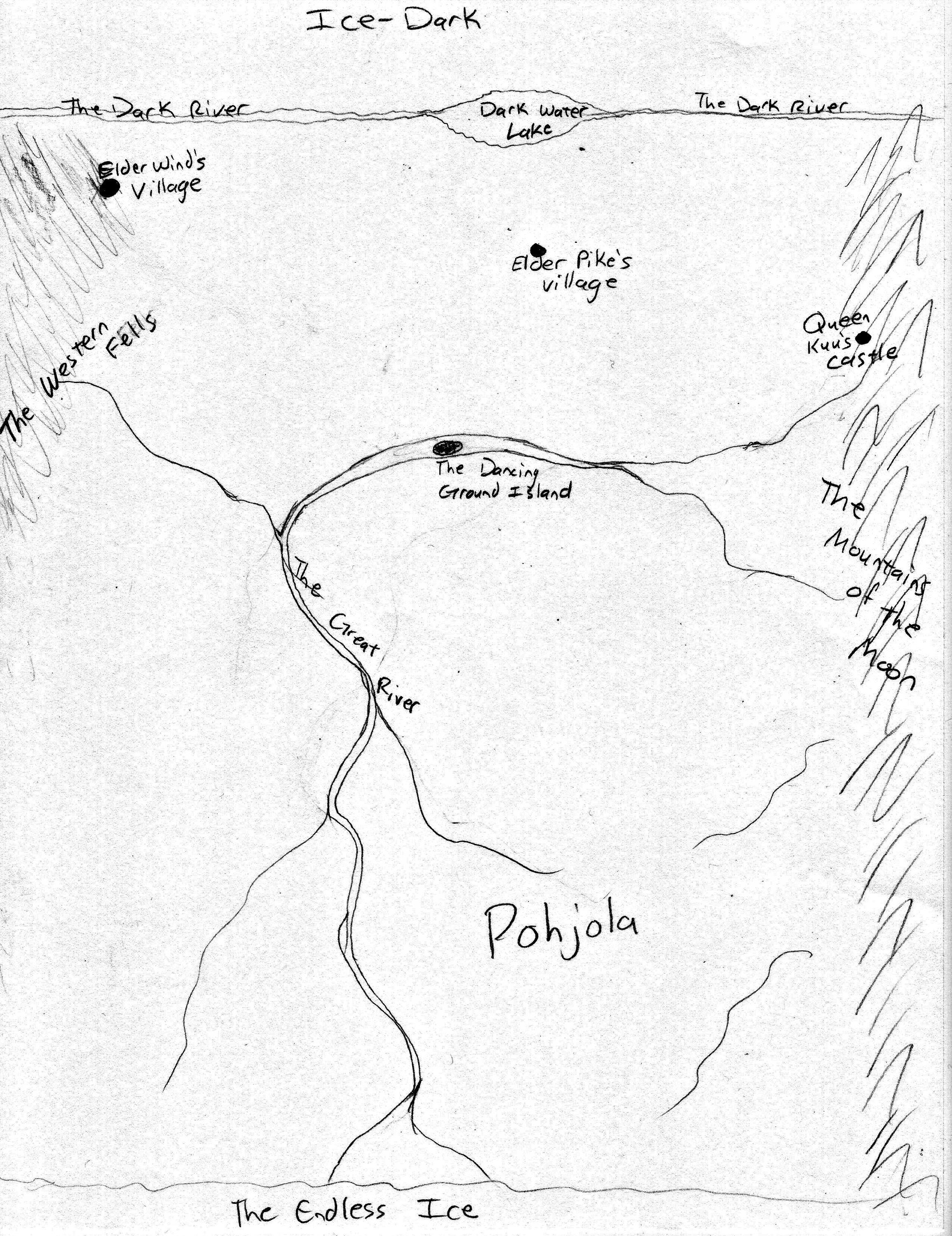
And so, since I’ve been singing the praises of maps this whole time, it seems only fair that I should provide one of my own maps. I’m not an artist, or a cartographer, and so I may have to engage the help of some skilled person for the final version—but here is a rough map of the land of Pohjola. The characters actually spend a good portion of the book traveling, so I quickly realized that some of my readers might appreciate a map. And even though I had the map of their journey all vivid in my head, it helped me to have it drawn out.

I’d love to hear your thoughts! Any other map lovers out there? Map-haters?

Comments, tweets, and Facebook posts are welcome. 🙂