Finding Peace, Hope, and Joy with Dylan Laine

For those who don’t know, in addition to writing this fabulous blog, I’m a regular writer for an online publication called Christian Media Magazine. I recently interviewed an up-and-coming music artist – you can read the original article and interview here. But since I do occasional music reviews here on my blog, I thought I’d share this post with you. Enjoy!

*               *               *

I had the honor of interviewing Dylan Laine, a new voice in the Christian music scene. She’s not a newcomer to music, but she recently made a decision to change the direction and message of her music. Songs of anger and depression are now songs of peace, hope, and joy, and she wants to share this message with the world. I’ll let her do the rest of the talking:

Q: So you just launched your first EP. What is it called?

Yes! My debut EP is self-titled, “Dylan Laine.”

Q: When did you first get started with music?

Well, I remember being five years old and standing on my parent’s dining room table, belting out Enya’s “Sail Away” at the top of my lungs over and over until my voice was gone. My grandparents bought me a piano when I was seven, and shortly after I was taking classical piano lessons, I participated in choir during every year of my schooling from elementary through high school, and used books to help teach myself guitar and ukulele. A combination of my piano education, choir involvement, and love for performance led me to dabble in being a singer-songwriter. Once I realized I could mix my hobby of writing poetry, with piano, guitar, singing, and performing, I never looked back!

Q: This new EP is not the first music that you’ve written or recorded. What sort of songs have you done before, and how is this EP different?

I have been writing and recording music for the last 13 years. In fact, ever since I was 13, I would record every song the moment I finished writing them so that they would never be forgotten. As of August 2014, I had an inventory of over 200 original songs written and recorded in a file on my laptop, titled, “All My Songs.” The majority of the 200 songs in that folder were inspired by the heartache, confusion, and frustration which consumed my life throughout my early teen years to my early twenties. In August 2014, I made a decision to erase all but five of my songs. The five songs left standing were centered around peace, hope, and joy.

Q: Did your decision to change the direction of your music come to you gradually, or was there a defining moment that made you change your mind?

After graduating Berklee College of Music in 2010, I spent four years trying to decide which direction to take my music. After marrying in June 2013, my husband and I made a commitment together to guard our hearts from movies, TV, music, and all other sources of media that promoted a negative message. In Luke 6:45, we learned that “the mouth speaks what the heart is full of,” and so we chose to fill our hearts with content centered around peace, hope, and joy. Once I implemented this decision into my day-to-day life, I knew that going forward in my music career, I had to apply the same principle.

Q: If you could sum up the message of this EP in just one sentence, what would it be?

You really are so loved.

Q: Would you say that your goal and vision is to use your music as a ministry?

My life is my ministry, whether it’s through my music, my conversations, or my simple daily choices. I would say my goal is to keep pressing forward, to never quit, and to always find the value in effecting even one person’s life for the better. My vision is that my audience will continually expand among Christian and non-Christian listeners, and that they will find encouragement through my lyrics so that they can feel passionate and safe to go out in the world and free-fall into whatever wonderful calling God has placed on their lives.

Q: Where would you like to be in five years – musically, as well as ministry-wise?

In five years, I would love to be making a living solely through playing live shows and selling custom songs as well as custom poetry. I am on my way, but there is much room for growth! My husband and I also have a dream to either start or be a part of a professional worship band. I would also like for my audience to extend out beyond (loyal and dedicated) family and friends, and to reach people from all over the world as I spend time touring and posting videos, using beneficial promotional tools such as YouTube and Facebook.

Q: What are some comments you’ve received from your fans?

The most frequent comment I hear from fans is that my music is very distinctive and refreshing. I love hearing this because one of my intentions when I put music out there, is to give listeners something unique to listen to.

Q: What’s your favorite part of the song-writing process – words or music? Which usually comes first?

There has been a pretty even balance of times that either the music has come first or the lyrics have come first. As far as my songwriting process goes, my favorite moment is when I realize that my idea is one worth using, either musically or lyrically, and then I know that I get to spend the next hour or two developing that idea.

Q: Do you enjoy performing live, or are you more of a studio artist? Any tours or shows coming up?

I absolutely love performing live! It’s a privilege to be able to showcase my art and to connect with people face-to-face. I don’t currently have any tours or shows coming up, but I am in the process of changing that!

Q: What’s your favorite song on your new EP?

My favorite song on my debut EP is, “Joy.” The lyrics embody one of the hardest lessons I’ve had to learn, which is to choose joy, despite my situation and circumstances, regardless of how unnatural it feels.

Q: Do you have a favorite song by someone else – either Christian or secular?

My favorite song is always changing, but as of now I love to blast Bethel Music’s, “You Make Me Brave.” The bridge build-up always gives me chills and leaves me feeling so encouraged and inspired.

Q: Do you have a favorite Bible verse, or a verse that particularly inspires you when you’re writing your songs?

Yes! My favorite bible verse is Philippians 4:8, which reads, “Whatever is true, whatever is noble, whatever is right, whatever is pure, whatever is lovely, whatever is admirable – if anything is excellent or praiseworthy, think about such things.” This verse has been the motive by which I strive to live and write.

Q: Any other final thoughts you’d like to share?

For many years, I used music as a way to escape and therefore, became very consumed in self-pity as I indulged in lyrics inspired by heartache. While it felt good temporarily to cry along with the music, or even justify my anger or depression with the music, it didn’t affect me positively in the long run. In the last few years, as I’ve begun to listen to worship music, I’ve been able to let those encouraging lyrics nourish me and lift my spirits, rather than drag me down or make me cry like I had done in previous years with secular music. I want to challenge others to try letting go of secular music for a week, and to find music that is inspiring and uplifting, just to see if there are any noticeable positive changes, as I have experienced in my own life.

I believe that Dylan’s message is a powerful one, and a much-needed one in today’s world of darkness and heartache. If you’d like to find out more about Dylan and hear her music, you can find her online:

Dylan’s website: www.dylanlaine.com
Dylan on Facebook: www.facebook.com/dylanlainemusic
Dylan on Twitter: @dylanlainemusic
The Nitty-Gritty of Writing: Capitalization

Some days it seems like basic capitalization is becoming a thing of the past. With texting, auto-correct, and even intuitive typing in word processing programs, it’s easy to just not bother with a silly little thing like capitalization. I’ve been guilty of rushing through a text and not bothering to check and see if my phone automatically changed the i to I or not.

Typos and all lowercase in texts to your friends is one thing, but when it comes to actual writing (as in a blog post, story, query letter, resume, school paper, etc.) capitalization matters. I’m going to highlight just the basics here. Refer to your style manual of choice (Chicago, AP, etc.) for the finer points of capitalization for things like acronyms, honorary titles for individuals or groups, headings and subheadings in articles, and so forth.

The first word of a sentence

This should be a no-brainer. The first letter of the first word of every sentence should be capitalized, even if the word is “the,” like in this sentence.

Proper names

Proper names include:

People’s names – Joe, Sue Smith, or yours truly Grace Robinson

Place names – America, New York City, Grand Canyon

Other proper names (brands, stores, organizations, etc.) – the White House, the Blue Angels, Saks Fifth Avenue

In English, the only pronoun that gets regularly capitalized is “I.” This makes English unusual, because in most languages, the first person singular personal pronoun is no different from “he,” “they,” or “you.”

Book, movie, and song titles

Examples:

The Notebook – as in the Nicholas Sparks novel, or the movie based on his novel. If you’re writing about just a random notebook, it would not be capitalized – unless it’s the first word of the sentence, of course.

“Let it Go” – a perfectly normal phrase, but if you’re referring to the song from Frozen (see, more capitalization), then it now goes in caps.

Other Really Important Words

This is sort of a joke, and sort of not – it mostly depends on context. Unconventional capitalization can be used for humorous effect in a blog post, like this Really Important Post about Capitalization that you’re currently reading. Capitalizing ordinarily non-proper nouns is common in genre fiction like fantasy, such as the One Ring in Tolkien’s Lord of the Rings. “One” and “ring” are common, unimportant words, but in the context of that story, the capitalization lets the reader know that this particular Ring is anything but common.

One important thing to note, though, about capitalizing ordinary words for emphasis: it’s basically universally agreed that texting or posting on social media IN ALL CAPS is the equivalent of shouting, and should be used sparingly. And by sparingly, I mean putting ONE word in all caps for emphasis, NOT THE ENTIRE BLASTED POST. (That’s my opinion – and widely-agreed-upon internet etiquette).

So there you have it – a few small basic rules of capitalization. As I mentioned, please refer to an actual style guide if you get bogged down with capitalization details. But in the meantime, sticking to these basic rules for school papers and internet posts can help add a little professional polish to your work.

Happy Valentine’s Day from a Few Fictional Couples

To celebrate Valentine’s Day, here is a brief post about romance. I’m not a reader or writer of the romance genre, but I like a good love story as much as the next gal. So here are four of my favorite couples from sci-fi and fantasy.

Éowyn and Faramir – Lord of the Rings

I could have picked Arwen and Aragorn from this series, but I actually like the story of Éowyn and Faramir’s relationship better. There’s less romance, since they don’t actually get together till the very end, but I like how these two tragic characters who have faced death and lost loved ones find healing and joy with one another. And their union helps to re-forge the ties between the kingdoms of Rohan and Gondor, so that’s always a plus, too.

Helen Rossi and Paul – The Historian

This couple is from a book that I recently read called The Historian. (I discussed this book briefly in another post here). These two people wind up together on an unexpected quest to find a common loved one who’s gone missing (Paul’s professor, who is also Helen’s father). Since the story is told in the first person by Paul, we get only his feelings for Helen, but the author did a beautiful job of showing Helen’s growing affection for Paul even without getting the reader into her head. Although the actual “love scenes” in this book are minimal, the characters’ passion for each other is evident on every page.

Gomez and Morticia Addams – The Addams Family

I mentioned the Addams family and love in another recent post. Gomez and Morticia are well known for their propensity to drop whatever they’re doing at any random moment and engage in a passionate encounter. But in addition to their chemistry and sweet murmurings in French, they have a solid, deep love that is never shaken by external or internal conflicts. They are a together-together couple who raises their family with strong (albeit bizarre) values, and they show unconditional love to everyone in their family.

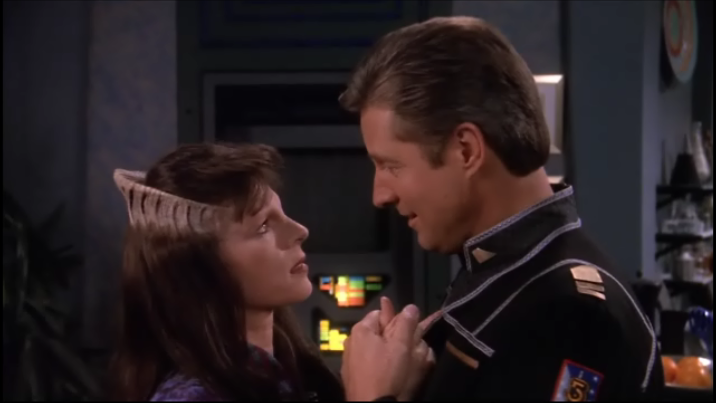
John Sheridan and Delenn – Babylon 5

This pair is probably my favorite fictional couple ever. There’s a lot to say about these characters and the way that their relationship is written into the story. Their romance grows slowly and naturally – it takes a year and a half before they begin to realize their feelings for each other. They’re from different races (which used to be at war) and so the cultural tensions are always subtly present, even after they’ve been married for years. I also like how these two stay happily married, even through the rough spots, and they always make decisions together as a couple. (Short-term romances seem to be very popular in TV shows, and almost expected in sci-fi TV shows, after the precedent set by Captain Kirk in classic Star Trek.) Also, all of the other characters (well, most of them) love Sheridan and Delenn as a couple, and are constantly supportive of their relationship. Their goodbye to one another at the end of the series is one of the most poignant partings ever (can anyone watch the finale “Sleeping in Light” without crying?)

Delenn and Sheridan, from "Babylon 5"

Delenn and Sheridan, from “Babylon 5”

So who’s your favorite fictional couple? Please share!

Live Forever

Last month I submitted a short vignette to a writing contest. This contest was put on by the Iceland Writers Retreat, and the grand prize was a free ticket to the conference in April. I did not win (*sob*) but I’m glad I participated, and I send all congratulations to the winner. (You can read the entries by the winner and the two runners up here – which I encourage you to do, after reading my post here, of course).

The rules were simple – write 500 words inspired by an image of the Harpa Concert Hall in Reykjavik. I won’t put their image in my blog post, of course, but I will give you a similar image that I took when I was in Reykjavik a couple of years ago (too long ago! I need to go back!)

Anyway, here’s my little piece, and a lovely picture of Harpa to go with it. Enjoy!


Live Forever

“If anyone is suicidal, they should come here,” he says to me.

“What?” I turn from the view of the bay and stare at him. “You are so insensitive.” It’s been a few years since my cousin died, but still…

“I am not. I mean, my God – just look.” He waves his hand at the vista before us.

A fierce wind is blowing, turning the water into a basalt gray; mere moments ago it had been a rosy yellow like the sky. I know it’s a fierce wind because I see the boats jumping on the water, but we’re safe inside this concert hall of glass. No, it’s more like crystal. Great blocks of manmade crystal, all glass-smooth, put together like a giant puzzle. Stairs, walls, ceilings – you can see through everything. It’s half mathematical wonder, half art masterpiece.

“We may be a hundred feet up, but it’s not like anyone could get through this,” I say finally, laying a hand against one of the clear cubes of the wall. “And I didn’t see any balconies on this place.”

He looks at me. “Now who’s being insensitive?”

“You brought it up.” The sky is turning white with clouds. I’m glad I wore my thicker boots today – by the time we leave, it might be snowing.

“So?”

“So, you just…oh, never mind. You’re a jerk sometimes, that’s all.”

I expect him to get huffy – or maybe just laugh off my insult, which is more annoying than when he gets huffy. But instead, he does neither.

My hand is still pressed against the cold glass wall, and he suddenly covers my hand with his. “I’m not being a jerk,” he says quietly. “Don’t you see it?”

I look at him. “See what?” I ask.

“This. Everything.” He grips my hand. “Stop being so pragmatic for just a minute. Stop thinking about how we’re probably going to get caught in a snowstorm, or how much our coffees cost earlier, or how a jumper could actually get outside this building so they could fall to their death in the water.”

He’s never talked like tHarpahis before. His face is strangely bright in the gray light coming through the glass. I want to ask him what he’s talking about, but suddenly I don’t know what to say.

“If anyone is suicidal, they should come here,” he says into my silence. “The water, the sky, the mountains, the light… There’s too much beauty, and you feel like you’re on top of the world. There’s no way you could end it all here, no way you’d want to anymore.”

The snow starts, tiny crystal flakes dancing just past our fingertips. The overcast grayness has suddenly brightened into joyful white light. Now I understand him.

“If anyone came here wanting to die,” I whisper, “they’d realize that they could live forever. And that it would be beautiful.”

Unusual Narrators

I am not an expert on all the ins and outs of the narrator or narrative voice in fiction. Most of my stories wind up being in the third person, and often from multiple characters’ points of view. Before you jump all over me for that, let it be known that a) I never head-hop within a scene, and b) I’m currently writing an epic fantasy trilogy, and it just wouldn’t work if I had only one P.O.V. character.

Anyway, despite the fact that I have experimented very little with my narrators, I’m fascinated by the concept of the role of the narrator. I’ve decided to make this blog post a brief study of several unusual narrators that I’ve come across (in both books and movies).

The role of the narrator is first and foremost that of storyteller. Whether it’s omniscient third person point of view or an individual character who says “let me tell you my tale,” we learn the story from a narrator. Since I like the telling of stories, I’m always fascinated when I encounter an unusual storyteller.

Unusual Narrators in Movies

Okay, so both of these that I’m going to talk about are technically stage productions, but I’ve only seen the movie versions. The story and the characters would be the same, though. The musicals Evita and Joseph and the Amazing Technicolor Dreamcoat feature very unusual narrators to tell the story. The narrator Ché in Evita and the unnamed Narrator in Joseph both actively participate in the story, even though they are not characters within it. This is a technique that seems like it would be more effective in a show or movie rather than a book.

Ché and Joseph’s Narrator set up the story, introduce the characters, and then take the audience on the journey of the story. Both of these narrators are in just about every scene and every song, but not just as a distant storyteller – they interact with the scene and the characters within it. The characters in both of these stories are unaware that the narrator is a being that exists outside of their world.

For example, in Evita, Eva has several duets with Ché, but she does not recognize him from scene to scene. Ché is simply there to represent the everyman (or sometimes her conscience). Similarly, in Joseph, the characters always greet the Narrator with exuberance and welcome her into the scene, but treat her as a passing fancy. Only at the end, when Joseph and the Narrator sing the final duet, does Joseph seem to become aware that the Narrator has been there all along, telling his story and giving him life. These two stories would actually make a great character study, as well, because of this unique interaction with the narrators, but I won’t go into that right now.

Unusual Narrators in Books

The two books I’ve decided to discuss are Rebecca by Daphne du Maurier and The Historian by Elizabeth Kostova. (Incidentally, I mentioned the narrator of Rebecca in another post I wrote some time back, in which I outline first, second, and third person points of view.)

Both of these books are written in the first person, which at first blush seems like the most limiting of all narrative styles, because the reader can never know anything beyond what the narrator knows. This is definitely the case in Rebecca, where the narrator’s ignorance and conjecture is basically what drives the plot.

The Historian features a very different sort of narrator, because there are technically several narrators. The main narrator (unnamed) is telling the story of her hunt for her father. She follows the trail left by her father based on the letters he’s written to her; these letters are first person, narrated by her father, and his narration (this narrator’s name is Paul) actually takes up the bulk of the book. Paul (via his first person letters) also followed a trail left his by his professor, so portions of the book are told in the first person by the narrator Professor Rossi. It’s a fascinating way to tell a story, and this technique enables the reader to experience multiple points of view (and even multiple time periods) while always staying in the first person. I found it occasionally confusing, though, as there were no markers to indicate when we were switching narrators (or time periods). Since everything was told by “I,” the reader has to rely only on the setting, and an acute awareness for each of the narrator’s voices, to determine who was telling the story at any point in time.

What’s also interesting about both of these stories is that the narrators are not actually the main characters. In Rebecca, we are in the unnamed narrator’s head the entire time and we get to know her intimately, but Max de Winter and even Rebecca herself are the major players in the story. In The Historian, the unnamed primary narrator quickly fades into secondary importance as we follow her father Paul as the narrator. At times reading this book, it was easy to forget that the “main” plot of the story was supposed to take place in the 1970s, because the majority of the story was told via Paul’s letters from the 1950s.

Other Unusual Narrators?

So now I’d like to hear from you. Have you ever read (or watched, or written) a story with an unusual narrator or narrative style? There are other stories I could have discussed here, but I’d love to hear some more examples from you!

And also, for your viewing pleasure, here is the Narrator from Joseph and the Amazing Technicolor Dreamcoat setting up the story and introducing the main character: