Story Prompts to Get Unstuck

I am not usually one who needs story prompts. I don’t mean for this to sound arrogant or bragging – it’s just that I’m usually so inundated by ideas that what I need is more time to write, not more ideas. But even us constantly-flooded-with-ideas folks get stuck now and then, or we want to take a break from current projects and try something new.

I’ve written a couple of posts in the past about generating ideas and breaking through writer’s block. I find that writing something else besides my current project can keep my mind in a writerly mode without it getting bogged down in whatever I’m stuck on.

I also started a Pinterest board with cool pictures and ideas for story prompts.

Another great source of inspiration for me is music. Sometimes ideas come to me while I’m listening to something, other times I purposefully play certain songs or tracks while I’m brainstorming. If you want to know what kinds of music get me going, here are some of my favorites.

I hope that some of these links can help you if you need prompts or brainstorming fodder. What are some of your favorite ways to get your creative juices flowing again?

Stories about Stories

I like stories, and so stories that are about stories seem doubly cool to me. I decided to analyze three of my favorite “stories within stories” and the different ways that this concept can be handled.

A Tale: “The Tale of the Three Brothers” in Harry Potter

I’ve read various cautionary articles about inserting a “tale” into fiction. Interrupting the flow of the plot for “storytime” can slow the action, take the reader out of the story, and is often a thinly veiled excuse for an unnecessary flashback. While all of these are true, I think there are still ways to use the “tale” inside a story without interrupting the main plot. Harry Potter and the Deathly Hallows does this very well with the “Tale of the Three Brothers.” One of the main things that makes it work is that this tale is vital to the rest of the main plot of the book. This tale isn’t an excuse for lame backstory or filler for a slow plot—without this little story-within-the-story, Harry wouldn’t learn everything he needs to know about the Deathly Hallows, which is vital to the rest of the story.

Plus, the tale was treated beautifully in the film. Honestly, it’s my favorite part of the movie:


Nested Stories and Flashback Tales: The Historian

If you’re not supposed to use tales within a story as an excuse for a flashback, then this book breaks that rule with every single chapter. This book is a bit unique, though, because the entire thing is a flashback within a flashback, and the different time periods of the story mesh perfectly to create the larger plot. I blogged about this book in a post I did about narrators, because all of the flashbacks are told in the first person, but by different people. This book isn’t really a good model for the average writer to follow, even though this author handled the writing style brilliantly. If you want to write a story within a story, it would probably be wiser to stick with a Harry Potter-esque “tale,” or a story about a story, as in the following example.

A Story about a Story: The Princess Bride

Since the book of The Princess Bride is very different from the movie—and probably more people have seen the movie—I’ll focus on the film for my example. The “main plot” of the story is the relationship of a little boy and his grandfather. Very little action happens, but there is character growth as the impatient boy realizes that his old-fashioned grandfather really isn’t as out of touch as he first thinks, and that they both share a love for a good story. The bulk of the movie, of course, is the fairy tale that the grandfather reads to the boy, The Princess Bride. The occasional hops out of the tale, like when the boy complains about the kissing scenes, are just frequent enough to remind the audience that this is a story within a story, but they don’t interfere with the flow of the plot.

Now over to you! Do you have a favorite “story within a story?”

Or a favorite Princess Bride quote? Just because.

The ABCs of Writing

WA while back I wrote a post featuring the ABCs of Fantasy Writing. For this post, I thought I’d branch out and do some ABCs for writing in general. Feel free to add your own words or ideas for different letters, and let me know in the comments!

A – Amazon. The place where everyone should have their book listed for sale.

B – Books. Duh.

C – Characters. What kind of story would you have without any characters?

D – Dialogue. When writing dialogue, don’t be afraid of using the word “said.”

E – Edit. Every book, regardless of length, genre, or talent of the author, needs a good edit. Probably several. And at least one round of edits done by someone other than the author.

F – Fans. That loyal following who will keep buying your books.

G – Genre. Even though mixing and crossing genres is very popular, most books still should fit into a broad genre like women’s fiction, fantasy, or non-fiction.

H – Hashtags. If you use Twitter (which you should be if you’re an author), then hashtags like #amreading, #amwriting, and #PitchWars can be very useful for getting yourself noticed.

I – Idea. All writing comes from an idea. Inspiration (I could have used that for my “I” word) can come from a picture, a single word, an event, or anything else. Without ideas and inspiration, there’s nothing to write.

J – Journal. Many writers find journaling to be very beneficial. It’s good for brainstorming ideas, documenting feelings and events for potential later use in a book, and just keeping the writing muscle active every day.

K – Keep going. If you’re frustrated with writing, keep going. If you got rejected by agents or publishers, keep going. If you’re stuck, keep going.

L – Love. Let’s face it – writing can be hard, tiring, sometimes thankless work. Most people who write – and especially those who have reached a level of success of some sort – do what they do because they love it.

M – Magazines. Getting stories or articles printed in a magazine – whether a commercial newsstand mag or a literary journal – can be a great way to get started with a writing career.

N – NaNoWriMo. This stands for National Novel Writing Month, in which people spend the month of November writing a full novel. If you’ve never participated in NaNoWriMo, give it a try one year – it’s fun and a good writing exercise, even if you don’t “win” it.

O – Outline. I know there are a lot of pantsers out there who write by the seat of their pants (hence the term “pantser”) and don’t use outlines. There’s nothing wrong with that, but even a rough outline can help keep your story on track. If you’re writing non-fiction, an outline is pretty much a must.

P – Plot. Even literary fiction that is more character-driven has some sort of plot. Nobody wants to read a story in which nothing happens.

Q – Question. To me, this goes along with “idea” and “inspiration.” I think that pretty much every story concept begins with some form of the question “what if?”

R – Reading. This is what we hope that people will do with our books. And as writers, we should be readers, too.

S – Social Media. Every author should have some kind of presence on social media. You don’t have to maintain a profile on every single social media site and join every new one that comes along. Start with a blog and a professional Facebook page. If you’re not using at least a little bit of social media, it will be that much harder to gain a following.

T – Thinking. Writers are thinkers. I often have a whole scene – dialogue and everything – worked out in the head, so then all I have to do when I get home is write it out.

U – Understanding. This is related to thinking, but to me thinking is a more purposeful, active word. Understanding can come with or without prior thinking, and can sometimes be hard to put into words (a frustrating thing for a writer). You can apply the word “understanding” to any part of the writerly journey.

V – Voice. That elusive yet definitive thing that makes your writing uniquely yours.

W – Writing. Duh.

X – Cutting. As in “x” something out. The editing process is frequently more cutting than anything else. That’s where I am with one of my novels – I’m saying goodbye to many passages, bits of dialogue, and whole scenes.

Y – Yay! Okay, sort of a lame word for “y,” but it’s a feeling that’s important to a writer. Celebrate your successes – even if it’s just finishing a scene.

Z – Zeal. Writing is a labor of love, as I pointed out in the letter “L.” But more than just love, I think approaching your writing with zealous excitement can go a long way towards keeping your motivation high.

The Color of Creativity

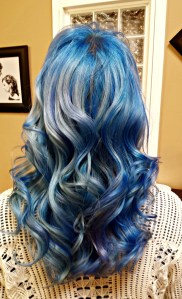
So I recently dyed my hair blue. Actually, my hair stylist did it, and a good thing, too. There’s no way I wanted to have at my own hair with bleach and a tube of dye. Anyone who follows me on Facebook (either my personal profile or my writer’s page) has probably seen a picture or two. So for those of you who haven’t seen me, here’s a picture:

My hair stylist rocks

My hair stylist rocks

The question I’ve gotten the most is, of course, “why?” Some have jokingly muttered about kids these days, and some have asked with genuine surprise and curiosity about what prompted such a radical and dramatic change.

My primary answer is that I thought it would be fun. And that’s true! I wear clothes I enjoy and jewelry I enjoy, so why not do something fun with my hair, too? I feel a bit like a fairy tale creature when I glimpse myself in the mirror, which just adds to the coolness factor. As a fantasy writer, it’s a special kind of fun going around feeling like a character in a story.

After a week of questions, comments, and a few silent disapproving looks, I started wondering if I had some deeper, darker reason for coloring my hair. Was I actually deeply and subconsciously distraught and this was my way of calling out for attention? Was I feeling stifled and blue hair was my way of rebelling? After wrestling with a lot of self-doubt (I’m so talented that I can have self-doubt about lots of other things in addition to my writing!), I concluded that I was not, in fact, mentally disturbed. All I wanted to do was dye my hair blue.

This got me thinking about stereotypes. Not everyone who wears goth makeup, is covered with tattoos and piercings, or has strangely-colored hair is dangerous or disturbed. (Please note – I am not putting down these different styles, and I’m certainly not belittling anyone who dresses a certain way because they’re searching for help.) Yes, the reason that stereotypes develop in the first place is because of the common traits within a grouping. But I know many people who do not fit their stereotyped group, and perhaps now I am one of them.

I colored my hair because I’m creative and artsy, and I decided that it was time for my outward appearance to reflect that. A couple of people expressed to me that with blue hair I would not look professional – which is true if I were trying to fit in the corporate world. But I am a professional writer and social media entrepreneur (or at least working my way towards that), and in that realm, blue hair is just as “professional” as any other color or style.

So maybe I did have a deeper reason for dyeing my hair, after all – to show the world that sometimes negative stereotypes can be wrong, and that blue hair is nothing more than just another color of creativity.

The Longest Short Story Ever


Six months ago I started writing a short story. To me, this is a very long time for a short story. I’m accustomed to working on a novel for years, because a novel by its very nature is a long-term commitment. But with short stories, I’ve always handled them one of two ways: finish it in weeks or even days, or not at all.

This particular short story I launched into with exceptional enthusiasm, because it was the inaugural story for a new fantasy world (different from the world of the fantasy novel trilogy I’ve been working on for years).

I had the whole plot worked out, had my cast of characters, knew the ending scene. I had the rules of magic and other world-building essentials already sorted out, because this was a revamping of some fantasy stories and a world I’d created as a kid. Basically, all I had to do was type up a few thousand words. So what happened?

Two things: life, and losing my focus.

The life bit wasn’t a bad thing. There were some changes – good ones – at my jobs, some opportunities came my way for some paid writing, and other stuff. I was excited about all of these changes, but the upshot was that a few months ago my life got suddenly busier and a lot more hectic. So with all of that, plus the novels I was plugging away at and this blog, the short story got pushed to the bottom of the pile.

The main problem, though, was simply that I lost my focus. I blogged at the beginning of this year about how I was going to take my fiction writing more seriously. I’ve been doing the bare minimums (keeping up with submitting installments of my novel to my critique partners, and keeping this blog going), but that’s it. But to be successful – or even to finish something – requires more than bare minimums.

And so, I finally got my rear in gear, I refocused, and I wrote a few thousand words and finished that short story. It’s been a long, rough road – that unfinished project, all mapped out and ready to go but still not done – was starting to really weigh on my mind. There’s nothing like the stress of an unfinished project.

So what did I learn from this long road to a short story? I learned that without focus and intentionality, even the shortest bit of writing can get pushed down in priority and left unfinished. I learned that all it takes is a little discipline to keep a short little tale from becoming a six-month headache.

I learned that if I want to be a writer, then all I have to do is write.