The Longest Short Story Ever


Six months ago I started writing a short story. To me, this is a very long time for a short story. I’m accustomed to working on a novel for years, because a novel by its very nature is a long-term commitment. But with short stories, I’ve always handled them one of two ways: finish it in weeks or even days, or not at all.

This particular short story I launched into with exceptional enthusiasm, because it was the inaugural story for a new fantasy world (different from the world of the fantasy novel trilogy I’ve been working on for years).

I had the whole plot worked out, had my cast of characters, knew the ending scene. I had the rules of magic and other world-building essentials already sorted out, because this was a revamping of some fantasy stories and a world I’d created as a kid. Basically, all I had to do was type up a few thousand words. So what happened?

Two things: life, and losing my focus.

The life bit wasn’t a bad thing. There were some changes – good ones – at my jobs, some opportunities came my way for some paid writing, and other stuff. I was excited about all of these changes, but the upshot was that a few months ago my life got suddenly busier and a lot more hectic. So with all of that, plus the novels I was plugging away at and this blog, the short story got pushed to the bottom of the pile.

The main problem, though, was simply that I lost my focus. I blogged at the beginning of this year about how I was going to take my fiction writing more seriously. I’ve been doing the bare minimums (keeping up with submitting installments of my novel to my critique partners, and keeping this blog going), but that’s it. But to be successful – or even to finish something – requires more than bare minimums.

And so, I finally got my rear in gear, I refocused, and I wrote a few thousand words and finished that short story. It’s been a long, rough road – that unfinished project, all mapped out and ready to go but still not done – was starting to really weigh on my mind. There’s nothing like the stress of an unfinished project.

So what did I learn from this long road to a short story? I learned that without focus and intentionality, even the shortest bit of writing can get pushed down in priority and left unfinished. I learned that all it takes is a little discipline to keep a short little tale from becoming a six-month headache.

I learned that if I want to be a writer, then all I have to do is write.

Live Forever

Last month I submitted a short vignette to a writing contest. This contest was put on by the Iceland Writers Retreat, and the grand prize was a free ticket to the conference in April. I did not win (*sob*) but I’m glad I participated, and I send all congratulations to the winner. (You can read the entries by the winner and the two runners up here – which I encourage you to do, after reading my post here, of course).

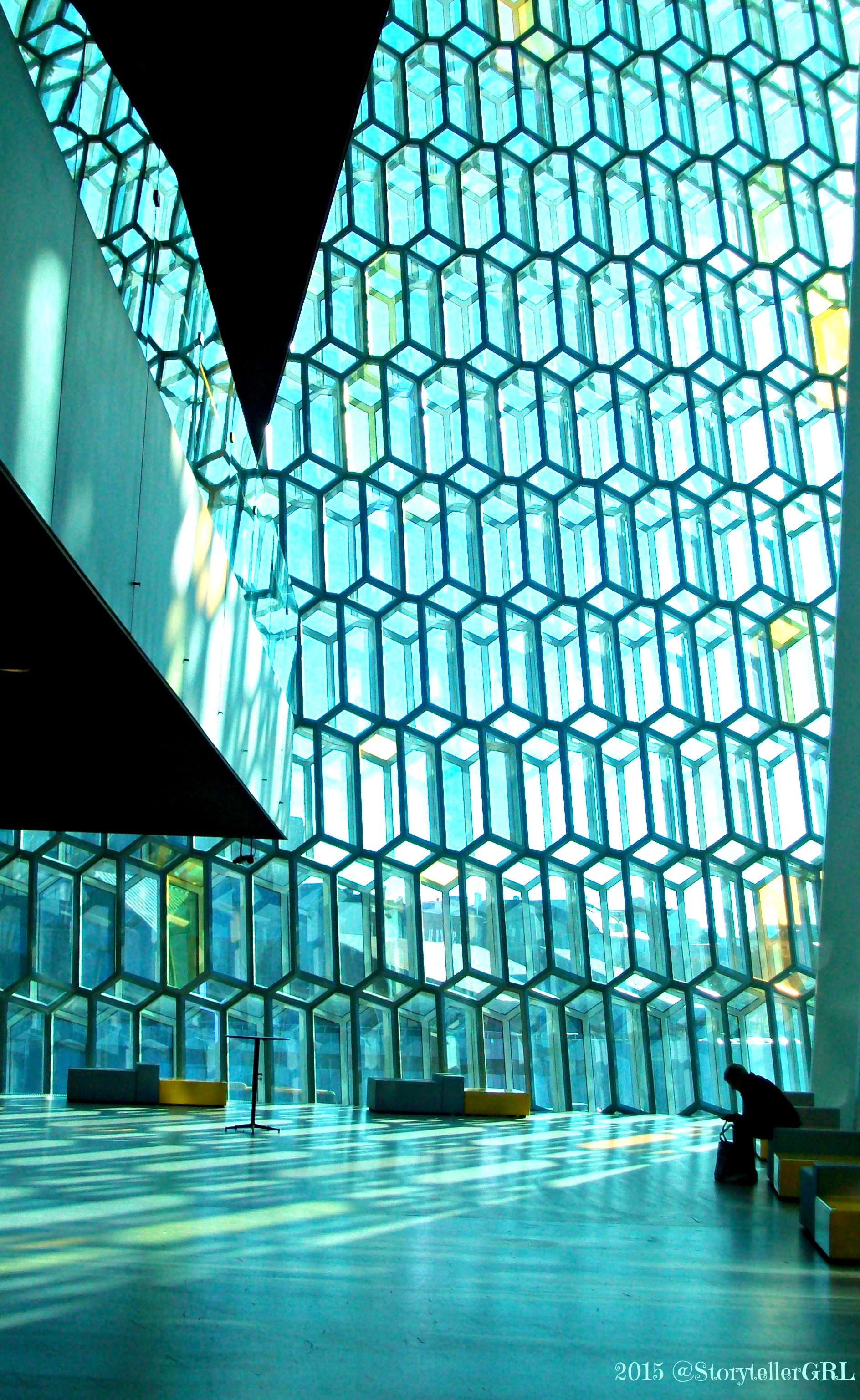
The rules were simple – write 500 words inspired by an image of the Harpa Concert Hall in Reykjavik. I won’t put their image in my blog post, of course, but I will give you a similar image that I took when I was in Reykjavik a couple of years ago (too long ago! I need to go back!)

Anyway, here’s my little piece, and a lovely picture of Harpa to go with it. Enjoy!


Live Forever

“If anyone is suicidal, they should come here,” he says to me.

“What?” I turn from the view of the bay and stare at him. “You are so insensitive.” It’s been a few years since my cousin died, but still…

“I am not. I mean, my God – just look.” He waves his hand at the vista before us.

A fierce wind is blowing, turning the water into a basalt gray; mere moments ago it had been a rosy yellow like the sky. I know it’s a fierce wind because I see the boats jumping on the water, but we’re safe inside this concert hall of glass. No, it’s more like crystal. Great blocks of manmade crystal, all glass-smooth, put together like a giant puzzle. Stairs, walls, ceilings – you can see through everything. It’s half mathematical wonder, half art masterpiece.

“We may be a hundred feet up, but it’s not like anyone could get through this,” I say finally, laying a hand against one of the clear cubes of the wall. “And I didn’t see any balconies on this place.”

He looks at me. “Now who’s being insensitive?”

“You brought it up.” The sky is turning white with clouds. I’m glad I wore my thicker boots today – by the time we leave, it might be snowing.

“So?”

“So, you just…oh, never mind. You’re a jerk sometimes, that’s all.”

I expect him to get huffy – or maybe just laugh off my insult, which is more annoying than when he gets huffy. But instead, he does neither.

My hand is still pressed against the cold glass wall, and he suddenly covers my hand with his. “I’m not being a jerk,” he says quietly. “Don’t you see it?”

I look at him. “See what?” I ask.

“This. Everything.” He grips my hand. “Stop being so pragmatic for just a minute. Stop thinking about how we’re probably going to get caught in a snowstorm, or how much our coffees cost earlier, or how a jumper could actually get outside this building so they could fall to their death in the water.”

He’s never talked like tHarpahis before. His face is strangely bright in the gray light coming through the glass. I want to ask him what he’s talking about, but suddenly I don’t know what to say.

“If anyone is suicidal, they should come here,” he says into my silence. “The water, the sky, the mountains, the light… There’s too much beauty, and you feel like you’re on top of the world. There’s no way you could end it all here, no way you’d want to anymore.”

The snow starts, tiny crystal flakes dancing just past our fingertips. The overcast grayness has suddenly brightened into joyful white light. Now I understand him.

“If anyone came here wanting to die,” I whisper, “they’d realize that they could live forever. And that it would be beautiful.”

Worldbuilding: The Why before the How

I’ve written several posts about world building for fantasy and sci-fi, but on this post I want to come at it from a slightly different angle. What’s more important than the how-to of putting together a new society or creating an alien race is why. Why do you want an alien species that can live on the surface of a sun? Why do you want steampunk airships powered by magic spells instead of gas or steam?

The coolness factor aside, what I’m talking about is getting you to look at the bones of your story and your world. Cultural habits, societal structures, technology and industry, animals both wild and domesticated – all of these elements of life are the way they are for a reason. It may not always seem logical or even right – like in the case of a society’s sense of fashion – but it still fits within the context of the larger world as a whole.

For example, in The Chronicles of Narnia, the Talking Beasts are more than just cute anthropomorphized animals to make the story appealing to children. Even if they originally started out that way, C.S. Lewis develops the Talking Beasts into their own culture. The reason for the existence of this fantasy culture is revealed throughout the stories. In Prince Caspian, the children encounter a bear who had once been a Talking Beast, but after living like a wild animal for too long, he lost the blessing of his speech and intelligence. In The Silver Chair, the giants kill and eat a Talking Stag, which solidifies the giants as the enemy in the minds of the characters and readers alike. It is not until the sixth book of the series, The Magician’s Nephew, where Lewis addresses the creation of the Talking Beasts as Aslan sets them apart from regular animals in order to live out a unique purpose in the world.

The how of fantasy worlds can be important – and the how is even more key in science fiction. But if there’s no reason within the continuity of the world or the story for something to exist, it will probably come across to readers as feeling contrived. What if C.S. Lewis had put the hrossa or the sorns of Mars from his sci-fi book Out of the Silent Planet into the world of Narnia? Those two Martian races are beautiful, gentle, intelligent creatures – but they aren’t Narnians. He designed them to live on a lush, cool, low-gravity planet, not a magical representation of Earth. As fantasy creatures, they’re every bit as engaging as any of Lewis’ creations – but he had his “why” in order in his mind, and so did not have to contrive some illogical reason to explain “how” the Martians were in Narnia.

A word of caution, though – it is not necessary for there to be a lengthy explanation of all the whys and reasons behind the creatures and customs. As in my Narnia example, all of those details were worked into the story itself.

I know it’s tempting, after you’ve gone to so much work to create this elaborate world, to share every little detail and bit of backstory. If a detail can be worked into the story without pulling the reader out of the plot and into a textbook, then do it; otherwise, it will have to live only in your head.

But the important part is that it’s there. You as the author must know and understand all these whys and details. Even if you don’t write it out in words, an astute reader is able to tell when a writer understands their world or not. Don’t hesitate to let your creativity flow while you’re building your worlds. Map out all the how’s and explanations of societal structures, magic, technology, and creatures. Just don’t forget to ask yourself why.

What Not to Say to a Writer

I am not a published author yet (as of the time of this writing), and I may not be as experienced as many writers, but thus far in my writing journey I have encountered well-meaning people who say some really not-so-great things.

Writing can be not only a lonely pursuit, but an odd one. Let’s face it: we walk around with whole worlds in our heads, every horrible or bizarre thing we see would work great in a story, and we struggle with choosing between two different words that actually mean the same thing. So I guess it’s no wonder that a) most regular people don’t understand us, and b) because of that, questions that would otherwise be polite or innocuous are not viewed that way by us.

Whether you’re a professional writer, or you’re just getting started and have told more than two people that you’re working on a book, I’d be willing to bet that you’ve heard at least one of these comments from someone. And if the comment didn’t annoy you or confuse you, then just wait.

Please note: I mean no offense to anyone reading this who isn’t a writer, nor any offense towards well-meaning family and friends of writers. My purpose here is to shamelessly elicit sympathy from other writers help non-writers to understand where we’re coming from.

How’s your book coming? (Or, when can I read your book?) When I’m able to answer this question with “The first shipment of my new book should be here next week,” I probably won’t mind answering this. But otherwise, this question really bugs me, and here’s why: no matter how much writing I’ve done lately or how well a project is going, I’m always thinking I ought to be farther along at this point and that the writing could be better quality. I’ve taken to answering the “when can I read your book” question with “when it’s finished.” And then when they ask when that will be, I repeat “when it’s finished.” Yes, I have some specific goals set for the stories I’m writing, but I don’t feel like telling people “I plan to be finished with draft three of chapter four of book one by next month.”

I wish I had time to write a book. So do I. So do all writers, probably. Nobody really has time to write a book. Those who want to write make the time. It’s not easy. Everyone is busy with jobs, kids, daily life. But writers figure out how to carve out time and write. If you want to write badly enough, you can do that, too.

My mom/brother/neighbor’s cousin wrote/published a book. You should talk to them! I love connecting with writers of all experience levels, and I believe there’s something I can learn from anyone.  The mom/brother/neighbor’s cousin is probably a great person and fine writer, but usually when I get this comment from a friend (or a stranger), the person talking can’t remember the name of the book, has no idea whether the author is self-published or traditionally published, and doesn’t know if said author is working on anything new. I appreciate the thought and wish the author all the best, but I don’t think I need to spend time figuring out if the published work is a series of main-stream novels or a church cookbook.

How do you write something that long? I can’t even write a short story. (I get this one a lot because I write epic fantasy. You might get some variation of this comment depending on what your format or genre is). When I bother answering this question, I usually laugh and say that I struggle to write something short (which is true). Then they laugh, and have no idea what to say next. I’m working on some short stories right now, in addition to a novel, but the two are totally different animals. Writing a novel is not just taking a short story and adding 40,000 words to it. I write long stuff because that’s what I like and what I’m good at.

Where do you get your ideas? This one annoys me the most. It’s not the fault of the person asking the question – they’re genuinely impressed by my creativity, and I should be flattered. But when this comes as a question, I truly don’t know how to answer it. I don’t go out searching for ideas – they come to me. Whether I want them to or not. I do understand that some writers need more prompts and inspiration than others, and then of course there’s writer’s block in all its forms. But my ideas usually come unbidden and at random times. Driving at night, I see a lamp post and get an idea for a story. A line of a song leads to an unrelated thought, and then there’s the seed of a story idea. I read a book, and that kicks my creativity into overdrive. If you’re looking for my secret idea formula, I don’t have one.

What other “please don’t ever say that to a writer” questions or comments have you encountered?

My First Writers’ Conference

This past weekend I attended the James River Writers Conference. It was a weekend-long event, but I was able to attend only on Sunday. Even so, this one day was enough for me to learn, get encouraged, and whet my appetite for other writers’ conferences in the future.

The event that I think I learned the most from was the First Pages workshop. During First Pages, selected works were read aloud – but only the first page. The panel of agents and editors then gave their feedback on what worked and what didn’t. I took a lot of notes. I want to be able to hook my readers right from the first page!

I think I enjoyed the Plotters versus Pantser panel the most. Four authors shared their writing techniques, and whether they tend to plot out a story in detail beforehand, or just write from the seat of their pants. The answers were actually mixed from all four authors. It seems like even the best pantser needs to have an outline and story structure going in, and the most die-hard plotter needs to leave room for creativity and organic storytelling. This was refreshing to me, since I call myself a plotter but often find that my outlines are woefully incomplete.

All in all, I had a great time at the conference. Even though I attend other smaller James River Writers events throughout the year, it was encouraging to see so many writers from so many different places all together. Published or still amateurs, fantasy writers and essayists – at the heart, we are all writers, and were there for the common purpose of improving our craft.

I will definitely go back next year, and I also look forward to attending some other writers’ conferences in other places very soon!

An artist illustrated the First Pages workshop. Fascinating idea, and so talented!

An artist illustrated the First Pages workshop. Fascinating idea, and so talented!