POV Pros and Cons

I’ve seen many beginning writers ask “what point of view should my story be told in?” I believe there’s no right or wrong answer to this, and certainly no one-size-fits-all answer. Many writers will start writing in third person, realize the story just isn’t working, and switch to first person, and then everything flows (or start out in first and switch to third, or some other combination). At any rate, the story itself should be the thing that tells you whether to write in first person, third person, one point of view, many, or some other arrangement. 

If you’re struggling with POV (Point Of View), here’s a quick guide that maybe can help you figure out what’s best for you and your story: 

Continue reading →
What is Art, Really?

What is art? It can be a hard question to define, especially in today’s world of AI generated art. One of the definitions given by Merriam-Webster is “the conscious use of skill and creative imagination especially in the production of aesthetic objects.” 

I don’t want this blog to dissolve into a rant (or argument in the comments) about the pros and cons of AI in the world of writing and visual art. I will say that I support it as a tool—just like other computer-aided art programs that came before, and computer-aided editing tools like spell check. But just like any carpenter or handyman will tell you, one tool is not enough—and no one particular tool is better than all the others. A range of tools, and the skill and knowledge to use them well, gives the handyman/artist the best opportunity to create an excellent final product. 

Continue reading →

Writing Out of Sequence: 3 Benefits to Writing Out of Order

Have you ever written a story out of order? There’s actually no rule that says you have to write in chronological order, or write scenes in the order that they’ll be read. Many writers – both plotters and pantsers – write a story in the order that it happens, either because they’re following their outline, or because they’re discovering how the story goes as they’re writing. 

I’m a plotter – I always have at least a rough outline before I start, and I have at least a vague idea of how I want the story to end. But that’s still a lot of “muddle in the middle” that has to get written, and I’ve found that writing scenes out of order can help keep me moving on a project, even if I’m feeling stuck. 

Here are three benefits I’ve found to writing out of sequence: 

Continue reading →

Of Moss and Stones that Roll

Mossy stones in the creek

You’ve probably heard the old phrase “a rolling stone gathers no moss.” There’s no proof of exactly who coined the term or when, but it likely originated as a Latin phrase and it’s been well-known in English-speaking areas for several hundred years now. 

The basic meaning of the phrase is two-fold. A somewhat negative spin on the phrase is someone who is a rolling stone has no home and no roots, and can never “gather moss,” or collect anything permanent like wealth, family, or stability. A more positive meaning is a person who is carefree with no worries or commitments, or a perpetual traveler who is a “citizen of the world.” 

Continue reading →

Inspiration from Nature

I’ve always been inspired by nature. Even if a nature scene doesn’t feature in what I’m writing on any given day, I still find my mind both calmed and awakened by a garden full of flowers, a shady path in a forest, a line of majestic mountains. 

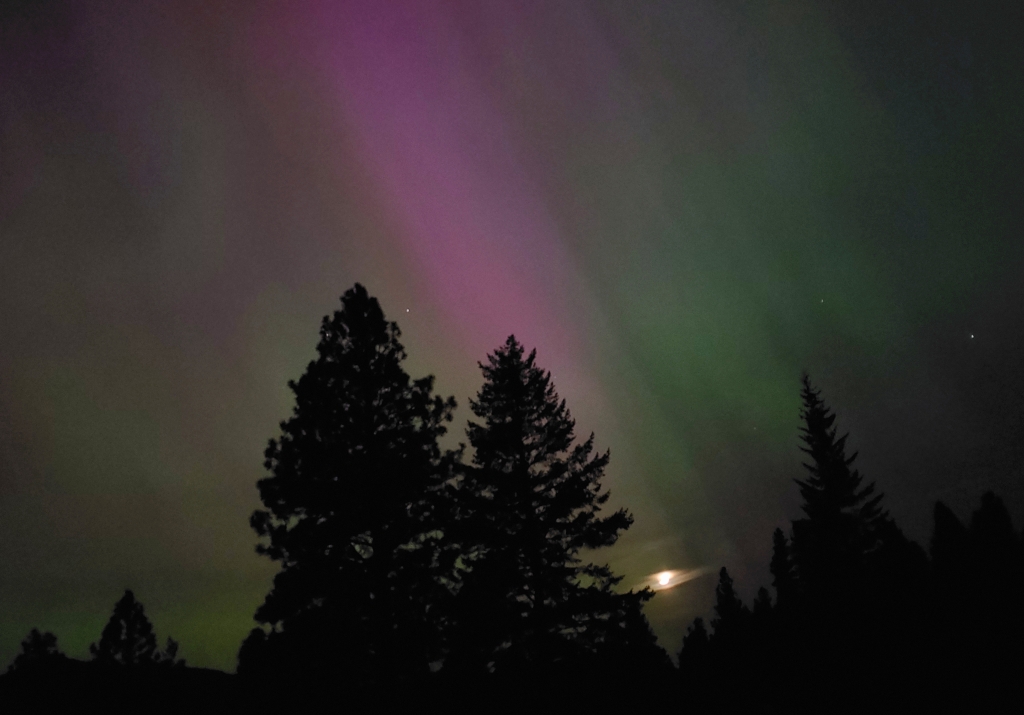
Earlier in May of this year, I was inspired—and awed, amazed, stunned, impressed—by an unusual natural view. I—and much of the rest of the planet—witnessed an incredible aurora display, the result of one of the most powerful geomagnetic solar storms in the past twenty years. Many people at latitudes that normally don’t get to see aurora got to see the Northern and Southern Lights. 

Continue reading →