It’s all in your point of view…

I believe that point of view (POV) can make or break a story. Well, maybe not break it, necessarily, but a different point of view can radically change a story.

A couple of other writers have blogged recently about POV, so I must do them credit by providing links to their posts. One of my favorite bloggers Ava Jae posted an insightful blog about POV, and editor Beth Hill wrote an exhaustive and very educational three-part post about point of view and character perspective.

To begin with, POV is one of three things: first person, second person, or third person. Each one has their pros and cons.

First person: I tells the story. The reader can immediately get into the main character’s head—the reader sees, hears, and feels everything that the character does.

For an example, I’ll use Daphne Du Maurier’s classic Rebecca. The story begins with an intense first line that puts the reader right away into the mind of the unnamed narrator:

          Last night I dreamt I went to Manderley again.

A disadvantage (or perhaps advantage, depending on how you use it) is that first person POV can be limiting. If important events occur that the narrator does not witness, the information must be revealed in some other way or at some other point in the story.

As I said, this could be either good or not so good. In the case of Rebecca, for those of you who’ve read it, just think how different the story would have been if Max de Winter had been the one telling the story. Without giving away everything to people who haven’t read it, let’s just say that there would have been a whole lot less suspense and intrigue if the reader knew everything that Max de Winter knew.

I wrote a sci-fi story a few years ago (it’s been temporarily shelved, but I haven’t given up on it) that was written in the first person from the perspective of an alien. The plot involved the alien on her way to visit Earth for the first time, and her first encounter with a human.

I enjoyed being able to create and tell about the alien culture basically from the inside out. The interesting challenge to this, however, was describing humans and their culture from the point of view of someone who didn’t know what hair or tear ducts were, had never seen a yellow sun in the sky, and didn’t even have the words to describe the food that humans ate.

Second person: You tells the story. This POV is almost never used, and is rather awkward. Really the only example (good or bad) that I can think of that’s written in second person are the Choose Your Own Adventure books. Anybody remember reading those as a kid? Those were cool because you were actually in the story. But as for reading, say, an actual novel, you as the narrator makes for a difficult read.

Third person: He or she (or it or they) tells the story. This POV form has the most options, which, like most anything, could be either good or bad.

The story can be told from the perspective of just one character, making it similar to first person in that the reader has a limited view of the story but very intimate knowledge of the character, their thoughts and feelings, everything that they do and why.

Multiple characters can tell the story, giving the reader not only knowledge of simultaneous events, but sometimes different perspectives on the same event or character. This format works best, in my opinion, for long complicated stories like epic fantasy (and other genres too, of course) that involve a large cast of characters and multiple plot threads.

The book I’m working on falls into this category. While I have two characters who would be the absolute main main characters, I have a cast of five characters who share the job of telling the story.

I keep the scenes separate as far as character perspective goes, however. I don’t know if this is what might be called a “rule” of narration and POV, but keeping the narrating characters separate within a scene is usually advisable. The best multiple-perspective third person POV stories I’ve read have separate scenes, or even separate chapters, for each character’s viewpoint. Switching mid-scene (or worse, mid-paragraph) from one character’s head to another can often be jarring or confusing for the reader.

For an example of third person, I’ll use an excerpt of a scene from my current book. This scenes that involves two of my main characters (Mađen and Teija), but it’s told from the perspective of Mađen.

          The sun was rising as they neared Sodankylä. Mađen paused at the top of a hill for a moment to admire the view. The snow was just mere flurries now and the clouds were thin, and a red-gold glow was blazing on the horizon. Wild sweeping hills stretched in every direction, dotted with little pockets of trees and rapidly freezing lakes. Towers of rock, softened only slightly by the fresh dusting of snow, rose up from the tundra. Everything glowed a muted orange in the veiled sunrise.

          “It’s beautiful,” Teija said.

          “Sápmi. It’s always been the most beautiful thing to me.”

          “Sápmi?”

         “The land of the Sami children. You call it Lapland, or sometimes Samiland. But our ancestors called it home.”

         Home—a land of ice and reindeer, rich traditions and dying languages. And because of his stupidity, he’d almost let that life slide through his fingers and be lost to him—again. He belonged in the north with his reindeer and his family. Ávgos and their animals would be brought back safely, if it was the last thing he did. He gunned the engine and sped down the hill.

          He stopped briefly in Sodankylä for food and fuel. Teija was uncomplaining, though she did purchase a thicker scarf before they left the village. Mađen saw no evidence of pursuit of any sort, either in Sodankylä village or out on the tundra. During another pause in the late afternoon to stretch and relieve themselves, Mađen noticed Teija examining her phone.

          “You’re not calling anyone, are you?” he asked.

          She looked up at him. “How could I? There’s zero signal out here. My mom called me earlier and my friend texted me, but I can’t reply to either one.”

         “Are you planning to tell them where you are?”

         “Johanna knows where I am—basically. Well, she knows I’ve gone to Lapland. Why? You seem really concerned about me communicating with anyone.”

         Mađen pursed his lips and tried to think of a good way to answer that. “I just don’t want anyone to think I’ve kidnapped you.”

Along similar lines in the third person POV is the omniscient narrator, which is basically just the author telling the story. Scenes and characters are all treated equally, and if the thoughts of any characters are discussed, the reader is informed of them by the author rather than having the characters themselves share.

A good example of this is in Beatrix Potter’s stories; the author is the narrator, and in The Tailor of Gloucester, for example, this omniscient narrator tells us what is going on with the characters of the tailor, Simpkin the cat, and the mice. These stories are of course children’s books, and this omniscient narrator form is more common in children’s stories (it was also the most common POV form used about 100 years ago, when Beatrix Potter began writing).

It’s rare, though not impossible, of course, for a story to mix POV forms. One book that accomplishes this mixing quite well is The Dreaming: Walks through Mist by Kim Murphy. There are three main characters who tell the story—two of them tell it in third person, and one in first person. Each POV and perspective is given its own chapter, with a heading featuring the name of the character. This is a great way to prepare the reader for not only the change in perspective, as the third person narration switches between Shae and Lee, but also for the dramatic shift when the first person I narrator Phoebe tells her part of the story.

Regardless of the point of view, or the viewpoint character(s) used, the reader can only know what the author chooses to tell. That’s why I mentioned at the beginning that POV and character perspective can radically alter a story.

For writers out there, do you have a favorite POV that you write in, or do you let the story and characters determine the narrative perspective? For readers, who do you like to have telling the story: first or third person, omniscient narrator or just one or two characters? Please share your thoughts!

So What About Maps in Novels?

I like maps. To me, a map adds a level of realism to a place, cementing it in my mind in a unique way—even if it’s a map of a place that I already know well.

I don’t often drive with a GPS. Usually (but not always), if I can study a map of the route ahead of time, and maybe have written down a couple of landmarks like a noteworthy building or an exit number, I’m good to go. And once I’ve driven or walked a route two or three times, I pretty much have a map of it in my head.

For me, maps in books serve the same function. The map adds a dimension to the places in the book, and helps to frame the characters as they interact within that space. I’ve read a few blog posts about maps in novels (if I could remember which blogs, I’d link to them). There seems to be a bit of a divide as to whether people like maps in their novels or think them unnecessary fluff. Apparently, there are some literary critics who consider a map to be a “crutch” of sorts, useful only to writers who can’t convey setting properly or to readers with no imagination.

Personally, I’ve never encountered anyone who thought that way. But if you are of that opinion of maps in books, then I do apologize if I offended. No offense is meant towards anyone—this blog is, quite obviously, my own opinion; feel free to stop reading at this point, if you so desire.

For those who have kept on reading, I will continue to express my opinion and my love of maps. Yes, I’m partial to maps in books because I’m a lover of fantasy stories—and fantasy, more so than most other genres, lends itself to needing maps because the location is a place that absolutely no one (besides the author) is already familiar with.

If you’ve read any of Tolkien’s stuff, you were probably glad to have a map so that you could track Frodo’s journey across Middle-Earth, and find out where Minas Tirith and Minas Morgul actually were in relation to each other.

Or, take the Bone series by Jeff Smith (yes, I know this is technically a graphic novel—more on that in another post). A map, as drawn by one of the characters, is a very important plot point, in addition to the map helping the reader to understand the importance of the fact that Barrelhaven is nowhere near The Dragon’s Stair.

Maps don’t have to be relegated to fantasy, certainly. Most any story that involves traveling in some fashion, or that takes place in a distant or little-known place can at least be enhanced by a map. In Andrea Barrett’s The Voyage of the Narwhal, there is a detailed map of the west coast of Greenland and all of the nearby islands in the Canadian arctic. The book is a historical fiction tale about a sailing ship that travels through the dangerous waters of the high arctic; not the most well-known part of the world, especially when the 19th century names for places are used, so a map helps.

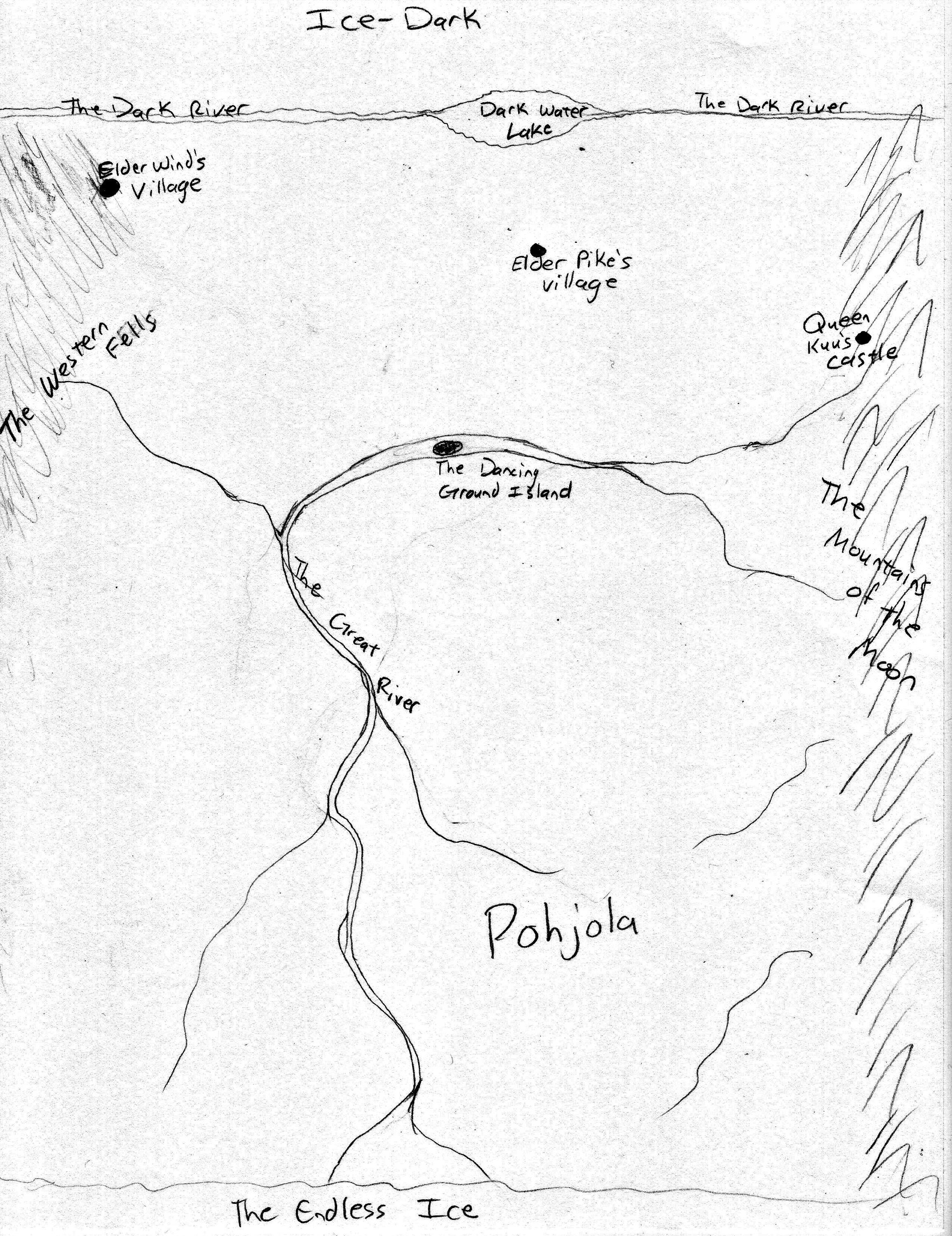
And so, since I’ve been singing the praises of maps this whole time, it seems only fair that I should provide one of my own maps. I’m not an artist, or a cartographer, and so I may have to engage the help of some skilled person for the final version—but here is a rough map of the land of Pohjola. The characters actually spend a good portion of the book traveling, so I quickly realized that some of my readers might appreciate a map. And even though I had the map of their journey all vivid in my head, it helped me to have it drawn out.

I’d love to hear your thoughts! Any other map lovers out there? Map-haters?

Comments, tweets, and Facebook posts are welcome. 🙂

Music to write by

I never listen to music while I write. Songs with words are way too distracting when I’m trying to come up with words of my own. Even instrumental music can be a distraction for me, unless it’s so in the background that I can ignore it, like blending with voices and other noises at a coffee shop.

That being said, when I’m not writing, I love listening to music. I’ll often just sit with my eyes closed, doing nothing but listening to a piece of music. I also listen to music while I’m driving (not with my eyes closed). It’s during these times of contemplative listening that I either get ideas for a story, or am able to delve deeper into the world of what I’m currently writing.

For the fantasy story I’m working on right now, I have several pieces of music that are my go-to tracks to get me into the right mind-set. Many of these tracks are by a band called Angelit, formerly called Angelin Tytöt. The band is from a tiny place called Angeli, in northern Finland. (Angelin Tytöt means “The Girls of Angeli,” and Angelit translates as something close to “The Angelis”).

Angelit’s music instantly takes me far away, both to real places I’ve never been, and imaginary places where I have been. If I’m brainstorming about a fast-paced scene I need to write, like a battle or some other adventure, I’ll listen to a song like “Garkit.” The loud beat and almost soundtrack-like quality conjures up the images I need, and I’m ready to go.

A more relaxing, mesmerizing song like “Gidda Beaivvas” lets my mind wander more slowly through my world. Sometimes images put to the music helps, sometimes all I have to do is listen.


The underlying theme in all of Angelit’s music is the Sami yoik and traditional music sounds. The band members belong to the Sami people (also known as Lapps)–the indigenous people who live in the high arctic of northern Scandinavia. Angelit usually sings in their native Sami dialect, rather than Finnish, and they incorporate variations of the Sami traditional “yoik” singing into their music.

This cultural backdrop is another reason why Angelit’s music serves as my muse for my story. The story is set in Lapland in northern Finland (yes, I promise it’s a fantasy story), and some of my characters are Sami. I realize that some cultural inaccuracies will occur, since I’m not a Sami and haven’t been there, but give me a little leeway–it really is a fantasy story, and the majority of it does not take place in Lapland. But whether I’m writing a scene that’s set in a real place or set in a place of my own making, the songs of Angelit always get my creativity going.

I’d love to hear some feedback! Any other writers out there who have a go-to song or two to get your creative juices flowing?

3 Reasons Why I Love Beatrix Potter

A few days ago I re-watched one of my favorite movies of all time—Miss Potter. In case you haven’t seen it, the film is a reasonably accurate portrayal of a span of several years in the life of Beatrix Potter. It covers her journey from a single woman bored with life with her parents and their pretentions at aristocracy to her life as a published author and wealthy community leader. The film stars Reneé Zellweger and Ewan McGregor (that should be reason enough to see it, with that line-up…)

Number 1: I love Beatrix Potter because she wrote some awesome stories. For a hundred years now, children have read and loved the stories about Peter Rabbit, Tom Kitten, Mrs. Tiggy-Winkle, and all the rest.

One of my personal favorites was The Roly-Poly Pudding (or The Tale of Samuel Whiskers, depending on the edition). There was something about that story that was creepy but fun, like ghost stories around a campfire. In the story it was chillingly cool that the house was so big that Tom Kitten could get lost for days before anyone might find him and that the walls were three feet thick.

In reality, if I lived in a house where I could hear dancing and partying inside the walls, and there were rats big enough to run off with things like rolling pins, I’d move. But Beatrix Potter turned it into an adventure story, complete with the thinly-veiled moral of “always obey your mother.”

Number 2: I love Beatrix Potter because her life inspired the Miss Potter movie. Did I mention that this movie is one of my all-time favorites?

One of the things I love most about the movie is the way that the director brings the audience not just into Beatrix’s life, but into her creative process and into her mind. There are little moments—just a few, and very subtle—when Beatrix’s drawings come to life and respond to her. These moments are not long or overt and don’t interfere with the stodgy Victorian setting—they’re just little animated tweaks that let the viewer know how deeply Beatrix was involved with her characters and art. How real they were to her.

As a writer, I can readily identify with this concept. My characters are my friends; I enjoy spending time with them, and sometimes we even argue. For example, right now one of my characters (Teija is her name, and she’s normally a somewhat timid girl) is loudly banging on my mind to remind me that I left her last scene hanging much too long ago and when am I going to finish it already.

There’s a scene in Miss Potter when Beatrix is trying to cope with a sudden tragedy in her life and she stays up all night sketching—only to have her beloved Peter turn away from her as she’s drawing. Peter Rabbit, frightened by his creator’s sadness and anger, flees from her, running away through the various drawings scattered across her desk.

The pencil sketch of Peter Rabbit hides behind some flower pots in one drawing and peer out at her, as if to give her firm instructions: “don’t you dare try to paint me or tell my story until you’re in a better frame of mind.” Peter may be a troublemaker of a little bunny most of the time, but in that instance, he is giving his creator some sorely-needed guidance.

Any other writers or artists out there besides me and the movie Beatrix who have experienced this? Have you ever felt guided (or even pushed) by your characters, instead of the other way around?

Number 3: I love Beatrix Potter because she achieved every writer’s dream. No, not every author or artist wants to live on a farm in the country raising sheep, but she did that because she loved it and she was making enough money with her books to live the lifestyle that she wanted. Control over their own life is every person’s dream to one extent or another, I believe. Not everyone will achieve this dream—and not every writer will get rich with their books—but the way I see it, if even one person did it, then there’s a chance that someone else can, too.

Beatrix Potter not only gained control of her lifestyle with her books, but she accomplished what is perhaps an even deeper universal dream—she created a legacy. She wrote something worth reading long after she was gone. More than 50 years after her death, and her stories and drawings are still bringing joy to children everywhere.

I’d love to hear your thoughts! Any other fans of Beatrix Potter out there? What author’s life story has inspired you?

peterrabbit_group_800

Some legal disclaimers, just in case…

Frederick Warne and Co owns all rights and copyrights to Beatrix Potter’s works

Miss Potter, 2006 by Phoenix Pictures, directed by Chris Noonan

My imagination

I’m new to this blogging thing, but I’m not new to writing. I know that no one has heard of me as an author, but I’ve been inventing stories since I could talk, and writing down stories ever since I could spell. I have what many might call an over-active imagination; but even during bouts of low self-image attacks when I tried to squelch my imagination and live like “normal” people, I found that I never could manage to turn it off.

So here I am, finally deciding to embrace my run-away mind and all the worlds it creates. So now the question is, how well will that translate into a blog that people actually want to read? Or, better yet, books that people want to pay good money for and read? Well, I’ll never know till I try…

To start with, I should probably talk a bit about what I’m currently writing (besides this fabulous blog, of course). I’m working on a fantasy trilogy—just finished the first draft of book one, and now I’m in the first re-write phase and have started book two. Four hundred-plus pages and 175,000-plus words of fantasy adventure…so now my goal for the re-write is to shave it down by about 50,000 words or so. I’ve trimmed off about 1,000 words (i.e. about two pages) of unnecessary fluff so far. A good start, right?

The term “fantasy” can encompass a lot of things, so to briefly describe this trilogy, I would call it either cross-world fantasy or just straight up plain fantasy (as opposed to urban fantasy, high fantasy, etc). It’s set in Finland, and involves the northern lights, reindeer, some musical instruments, and a dose of Finnish mythology. Sound interesting?

I hope so! I’ll be blogging in the future about some of the research that I’ve done for this series (yes, research for a fantasy story), and some of the things that have inspired me. And maybe I’ll even show a few excerpts from the first book. Time will tell…